

The United States is a sheep-shearing operation and one of the easiest ways to see the giant fraud is to look at hotel prices in other countries. This includes countries developed or not…or even just compare to the expectations of common sense. In 2015 or so you could get a very basic but decent room in central Madrid, a few blocks from the opera house, for about $30 per night. This was your own proper hotel room, with private bathroom, daily cleaning and so on, not a hostel, in one of Europe’s most pleasant cities. I’ve paid in the past even less for a room with private bathroom in a “pension” outside the central plazas of Lisbon. Around 2000-2005, you could get such a room for $5 a night. They had at the time a freaklike beggar with elephantiasis outside the Praca Figueira in the center, besides African idlers by the subway stations selling posters with a map of Angola. Prices are a bit higher now in the gentrified and happy Lisbon that’s a refuge for American tech and crypto professionals.
To be conservative you can say getting a room for under $100 a night in most of the world’s major top tier cities still is possible. You hear horror stories about Hong Kong, sometimes literally: a very successful Hong Kong movie, Dream Home of 2010, is a slasher tale about people literally killing for overpriced and rare private apartment space. You’d expect hotels to be insanely priced, but first time in Hong Kong I stayed in a big beautiful room in Wanchai, right in middle of a Blade Runner-hyperurban setting, with a great view of the mountains and skyline behind, for less than $90. And now on Hong Kong island itself, not Kowloon, you can still find Best Western or ibis genuine hotel rooms with private bathroom for less than $80 in very central locations as of spring 2026, decent size and with views. In Tokyo, supposedly the highest-price-per-square-foot city in the world, the first time I stayed in a central business district and paid about $65 for a small but perfectly reasonable, clean and modern room with good breakfast of various rice balls pickles roast fish soup and such. The Japanese-ultranationalist-owned APA chain is something I can high recommend for beginner travelers: clean, modern rooms in central locations, at times available for under $100 (for example in the decent Ueno neighborhood), and for only somewhat above $100 in very central areas like Roppongi. By contrast in 2015, which was the last time I spent any serious time in the United States, it was basically impossible to find anything for less than $100 on a January or February iced Tuesday night off the highways outside lovely New Haven, Connecticut. New Haven and Hartford are some of the premier “garden cities” of America, by which I mean it will give you autoimmune disease to live there from the stress of horrid Soviet post-industrial, “postracial” ugliness of the place. Any suggestion of finding a decent hotel to spend the night in a major city like New York for less than $100 registers as absurd to the average American because he’s a sucker used to being financially abused.
You are sometimes told that the reason medical expenses in the United States cost many times the same procedures in even highly developed foreign countries, for example in Japan or Spain, is because these latter are free-riding on American innovation in the pharmaceutical and medical industries. Thus supposedly the American has to pay a premium on MRI’s or blood tests because this extra money goes to careful Research & Development costs that are located in America solely and benefit the whole ungrateful world for free. Whether this explains why for example at-home nurse visits to draw blood for a routine exam are available to the upper middle classes in Europe and South America and Asia, but not at all in America, I don’t know. Maybe you can make that case. But I don’t understand the amazing American innovation expenses regarding everyday car rentals, which cost many times more in the United States over Europe; or the research-and-development angle on roadside possibly-bedbug-haunted motels run by the Patel family, that cost as much as a 4-star resort in parts of Japan…that justify fleecing the American consumer and making everyone there from the working class trucker to the recent-crypto-decamillionaire all into freiers. (Maybe it is the extra kilotonnage and horselike charm of the average American female today, average weight 170 lbs and BMI 29 including at ages below 30, that plays to male desires for more stuff and triggers in ambience such elevated cross-industry premium prices.)
A hotel as a mere place to spend the night is to me unreasonable over $40 or $50…even that seems somewhat too much if you think about it. I’ve often felt cheated on road trips where I had to blow $50 for a stay in beige-feel hotels when I had to pull in nondescript rustbelt-style South American or East European town only because night was coming. As a long time traveler I have contempt for the Neo-hippie types who spend their money in hostels smelling each other. At times I’ve visited hostels myself especially if I lived a long time on my own in a new city. Sometimes it gets lonely not speaking English in person…and I would just go to a hostel to get a drink and talk to people, tell them stories about hidden messages in phonebooks and so on, and then be asked to leave under suspicion of schizophrenia. But aside from this use, hostels are to be avoided as a scam of their own. Above all I can’t take the stink of other disgusting ape huemans…and to be made to share a room where sleeping you have to smell their dirty socks or hear them snoring; I’d rather take my chances sleeping on a park bench or the beach. At times driven by a righteous fury, I’ve composed, in ornate and official Spanish, letters to the Mexican and Colombian heads of the federal and civil police forces, begging them to shut down the hostels as affronts to taste, public hygiene, and political security.
But consider the cost of it; you can rarely get a hostel for anything less than $15 per day or usually $25 per day almost anywhere you go now, and it’s been like this for some time. For almost this price per day you can rent a cheap car, or in certain countries you can buy a used but working old car for mere hundreds of dollars. There’s also the cost of gas of course, but you can use such cheap car to drive around the hinterlands and countryside, and reach towns where tourists don’t normally go…this is by far the superior way to see a country. In Brazil in the early 2000’s you could drive to the interior where they had never seen an American; as a 22-year-old a carnal bonanza and celebration awaited you wherever you entered, besides enjoyable talks and parties with locals. You can also sleep in this car at times and avoid spending any money on “hotels.” With a cheap mosquito net in the summer or temperate weather, you hang that by the open window and can use the car to rest. I’ve had friends who did this even in dangerous countries like Zimbabwe…he slept in the parking lot of a casino in Harare. Sometimes you pay a bribe to the guard or a roadside cop. But hostels now are often filled with mystery meats and not always hot young Americans or Europeans. Then, outraged by the costs of hotels in the United States and unwilling to pay $100 for a night at a Gujarati-owned dump motel in apocalyptic Connecticut, I did this over there too, at times I slept in my car in gas station rest stops. But I had bad nightmares and was afraid.
You must realize in all that follows in this review series that unless you’re talking about taking measures like sleeping in your car or on the beach or such, if you do enter the normalfag “hotel market,” you can get cheated at $150-200 per night more than at $800-1000/night. There are, as I will show in time, certain hotels especially in Asia where you won’t feel cheated at $500-800 per night…and if you appreciate location as a theatrical display, you’ll maybe have a signature experience you’ll always remember…
My first times at really nice hotels in Asia finally changed my mind on this: a week at the Ritz in Nikko, ten days in the Upper House and a week in the original Mandarin Oriental in Hong Kong made me realize these are not just places to sleep a night…they’re without exaggeration immersive crafts and architecture experiences. For something like the Upper House in particular, or anything by the designer Andre Fu, there’s something in the actual physical energy of the place that doesn’t fully come out in photos. Upper House looks very nice in pictures, but it comes off somewhat generic, even “corporate”;
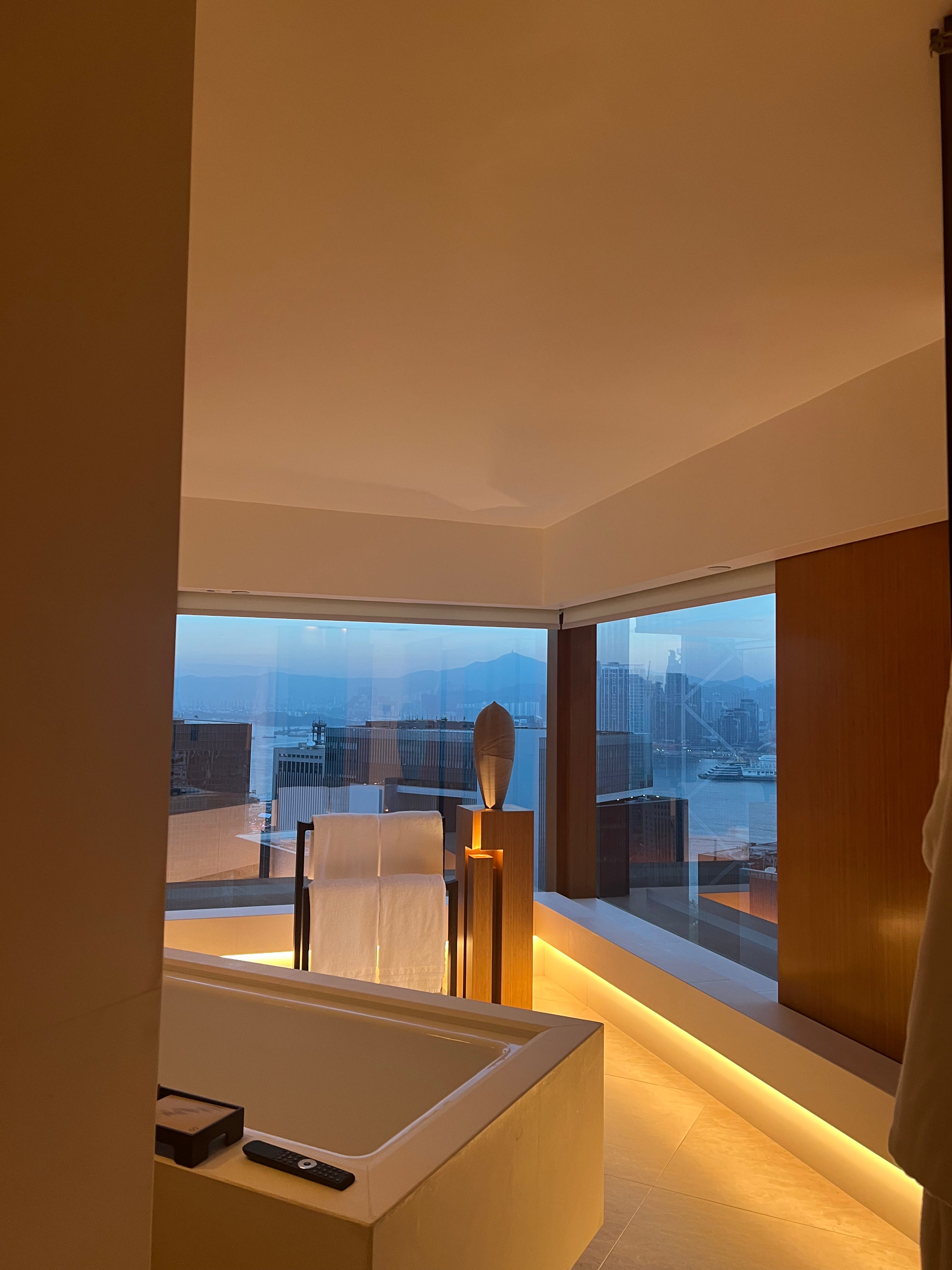
Upper House HK bathroom harbor view; my own photo
I stayed there on the very high recommendation of a friend I trusted and I wasn’t let down. In person it’s something else, it does feel magical, and it’s worth the $500-$1000 per night you’ll spend on the room. I’ll give a much more detailed review of these places later.
As a “Ghana-rich” idler with a show that makes me a lot of cash, no responsibilities, and a life of constant travel, I get to enjoy luxury airlines, restaurants, and hotels at will and so nothing much is lost if I stay gamble on a bad place once in a while. But even for a very wealthy man with a demanding job who takes his family maybe once or twice a year and wants a memorable time, a fraudulent review can turn into a wretched and dark thing, a missed opportunity, a spoiled year and time that’s forever gone—there should be grounds for lawsuits for such fraud.
This series of my Magenta Notebooks will cover hotels, restaurants and airlines as they occur to me from my past and present travels, with no specific order but only what I feel about writing on that day. The select audience I have, I got and kept from always telling the truth as I see it. In a time of proliferating fake luxury and fake and corrupt review sites, I hope to do a service for my readers and also those who are just searching properties or restaurants on Google or LLM and find these notes…let this be an aide to save you from bad decisions, or better, to help make good ones.
For me this means a location or hotel that excites you in a physical and direct way and makes your chest pound. I’m talking about places that, absent any freak accidents, will consistently deliver not just a good time but a near-magical experience that will linger for the year—such places are found almost only in Asia for a few reasons. Consider the famous hotel featured in Lost in Translation, where it plays as big a role in the setting of that movie as the city Tokyo itself, and for good reason. The recent renovation of the Park Hyatt in Shinjuku, Tokyo was undertaken as per Asian standards, where a five star is expected to go through a renewal at least once every twenty years. In this case the renovation was completed I think in December of 2025. Almost all the hotels I’ll recommend in this series are going to be in Asia. I haven’t tried hotels of this type in the United States, and I hear mostly bad things, but in Europe and South America it’s mostly not worth it. (There are notable exceptions, and in time I’ll review all that I’ve found). But even Europe’s “signature historical hotels” like the Hassler in Rome, where Prince Charles stays, or the Hotel Kamp in Helsinki…the most one could say about such places is “it’s a nice hotel,” but nearly all lack the absorbing magic of the new Asian palaces. In the case of the Kamp, which is legendary among Finns worldwide, it barely compares to a decent four-star hotel in Tokyo. There’s almost no relationship between a stay at the Aman in Tokyo or Kyoto and the extremely famous and overhyped Hotel George V in Paris…you stay at the latter only to say you stay there or to show on Instagram as a Chinese-style “status” luxury consumption marker. In Europe you will pay at least twice as much as in any Asian city, for a smaller room, annoying “official” and insincere displays of hospitality, and more important…for no feeling of enchantment. Again, from what I hear it’s even worse in the United States.
The basis for this feeling of genuine enchantment with a building isn’t necessarily so otherworldly—it starts, for example, with the use of very high-quality materials. Consistency on this changes the feel entirely. Hotels like the Capella in Singapore, the Raffles in Bali, the Kyoto and Tokyo Aman, etc., the Upper House and Mandarin Orientals in Hong Kong, have paid attention to the details of everything from the guardrails, the lamp fixtures, the curtains: everything is meticulously obsessed over to be (or at least to appear to be) only of the highest quality…the kinds of tropical wood that are used, the way these woods are treated and cured before use, and so on. Big-name and especially “historical” hotels in cities around the world, from Rio de Janeiro to Rome, Paris, Madrid, Simferopol, or wherever will coast on their reputation and their supposed sense of grandness, and try to impress with scale, but you will be very let down…something will irritate you, slowly, unconsciously and build up; then you look closer and you see why…they used cheap, light materials for the metals, aluminum even… the upholstery on the furniture looks like it’s from a government social security office, the carpets are bleak, sanatorium-feel and worn out in some places, and so on. This is true both for new modern-looking hotels and for “classical” design places that try to appeal to traditional tastes. A lot of the reason people have bad associations with “modern” architecture is merely that “recent construction” uses cheap materials whereas older buildings that have lasted were built with the best available at the time. But it’s very possible to build “classical” traditional buildings with second-rate ingredients, and then the fraud feels even more painful. A lot of the best “modern” architecture is in any case merely slight variation on Japanese aesthetics or principles…but this style only does well with the use of the highest quality matter. I will have occasion to comment in detail in the future on distinctions between hotels on this point.
A huge problem of all review sites and established magazines is the unjust lack of consistency that leads them to award equal praise to hotels vastly different in quality only because they think they have to find the supposedly good places in every location. So a once-in-a-lifetime memorable stay like at the Upper House in Hong Kong (at least as of a few years ago) gets the same types of words as a merely passable comfortable business hotel in Lisbon or a mediocre outworn wreck in e.g., Argentina falsely presented as an “art hotel.” The vast majority of “nice” hotels are just not worth it, but magazines like Fodor’s, Conde Nast and many other similar will obfuscate on this, whether out of democratic ideological convictions or just the need to serve perceived customer demand for “information”; or maybe basic corruption. The same is true for their restaurant ratings. Michelin was supposed to avoid this by simply refusing to rate cities that aren’t up to a consistent standard, but that time is long gone…a Michelin plate, or star or smiley face or whatever will just not mean the same thing in Paris as in Tokyo or Buenos Aires. The uselessness of these ratings systems has then called me to step in and assume responsibility!
My favorite hotels are the following: Capella and Raffles in Singapore, the Ritz in Nikko, Japan, the Mandarin Oriental and Upper House in Hong Kong, Raffles in Bali, Waldorf Astoria in Osaka, the now-closed Sinner Hotel in Paris; Casa di Langa in Piedmont gets a special mention for now. In time I will review all of these and more, but I can recommend them without any hesitations and almost promise that you’ll have a special time at any of them. In Tokyo, though I haven’t stayed there myself, I’ve visited friends staying and I can highly recommend also the Aman and Park Hyatt Shinjuku. A stay or even a visit for afternoon tea (famous at the Aman among elite Japanese ladies) to one of these palaces equals or exceeds a visit to a major well-known temple in Tokyo; at their best, the modern top hotels are immersive aesthetic experiences minus the “cultural outing” pretense and the obnoxious tourists on their enrichment hour.
Reviews to follow shortly…
Looking forward to this series. Forgive me for posting cringe, though I think the point is apt; a good hotel to me should feel like Hotel from Porco Rosso, the famous Ghibli film. A place of rest and repose, worth a repeat visit. The word you use ("enchanting") is just right. Perhaps 'cosy' would be another.
Bronze Age Hotelier