

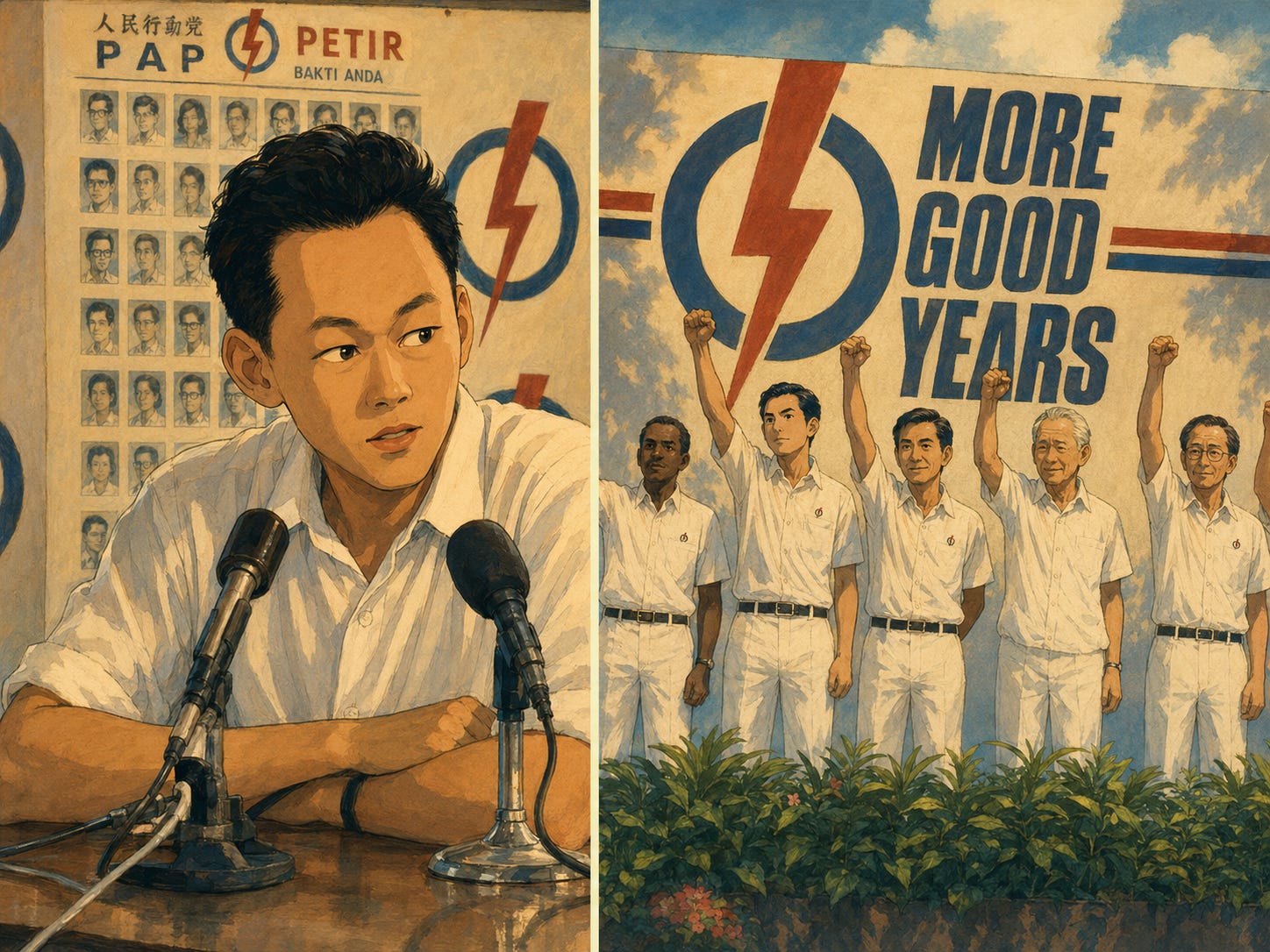
Here is a recent example of an ongoing debate among liberals and conservatives over the meaning of populism, Victor Orban, Lee Kuan Yew, and government form:
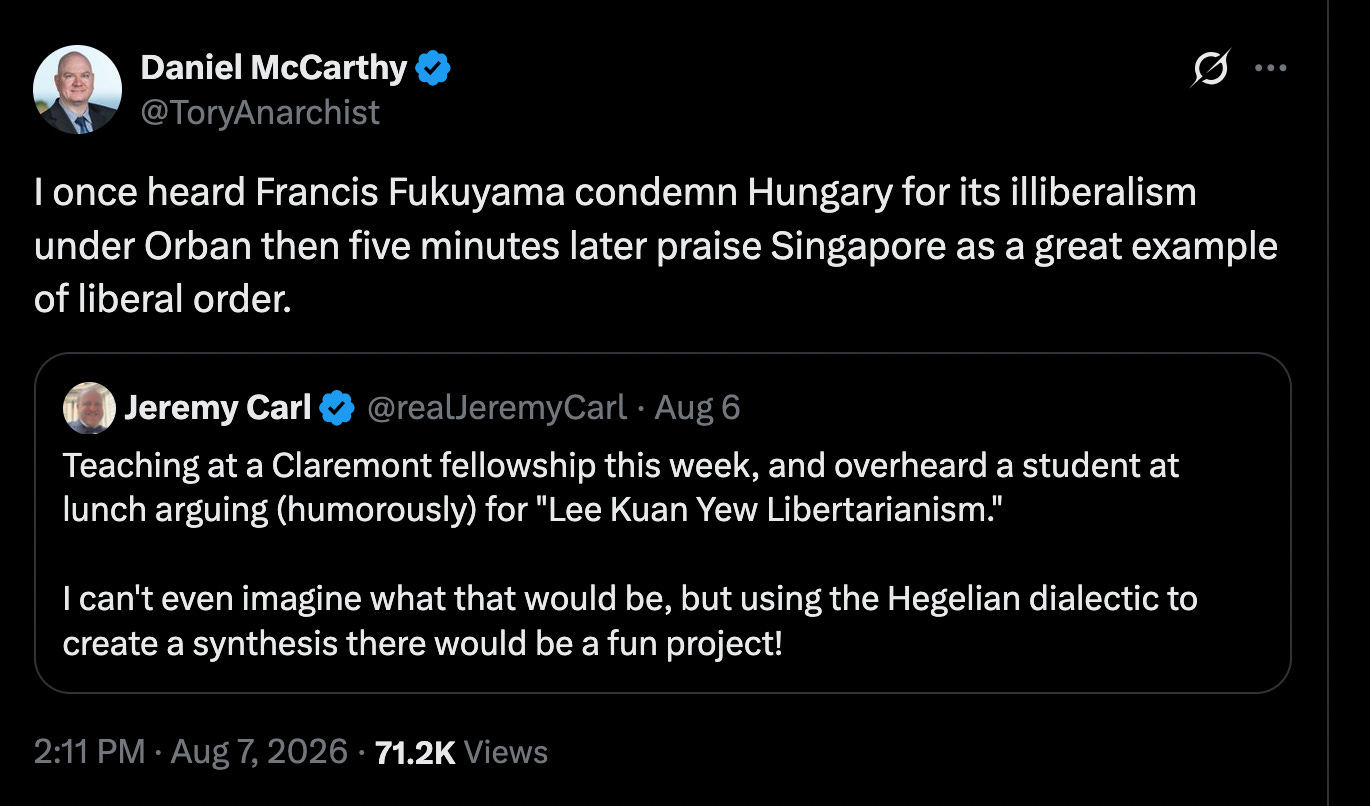
At center of this debate ultimately is the meaning and direction of whatever it is you want to call the Trump Moment of 2015-6. What will come, if anything, from the changes he effected within the American right and possibly in American government? I think both Fukuyama and his populist-nationalist critics (or call them whatever they want to be called, “nationalist-conservative” I don’t care) are wrong on the meaning of Orban versus Lee Kuan Yew. But Fukuyama’s mistake is ultimately less damaging, because it’s merely defensive for his rather moribund faction…and less consequential. The more I’m reading about Orban and his government in Hungary for the last sixteen years, the more I see it’s been a bad thing for that nation and I suspect an even worse thing for the international right…it has consolidated and encouraged the very worst tendencies of the Western conservatives. Orban has unfortunately been very successful in effecting his policies. But so his tenure is a good example of what an ideal-case 2010’s Populist Success looks like. It’s a distortion and betrayal of the potential of the Trump moment in 2015. The misinterpretation of this turn encouraged by Orban and the operational and intellectual biome that has developed around him will result in decline and failure in the medium-term for critics of international liberalism.
Orban versus Lee Kuan Yew, Fake
Fukuyama and a few others like Fareed Zakaria and Max Boot have repeatedly praised Lee Kuan Yew while condemning Orban in ways that open them up to accusations of hypocrisy. In fact Lee Kuan Yew is the far superior statesman to Orban, and a good model for governance, whereas Orban is a bad one. But these men can’t make the real case for why, because they’re ideologically cornered, subservient to convention, and compromised maybe in front of those who are their friends and allies. They have to contrive continuous and invidious revisions of the meaning of “liberalism” and “liberal order,” to define who is or isn’t part of the “liberal order,” or who is a threat to it.
On one hand “you are praising one dictator as liberal while damning another as opposed to liberalism” isn’t such a good gotcha at all…and Fukuyama himself superficially has counterarguments to this. In the books and articles that made his name around the time of The End of History, Fukuyama presented actually Lee Kuan Yew and Singapore as a plausible alternative model and challenger to Western liberal democracy. He referred to it at the time as a kind of “soft authoritarianism.” Fukuyama but also now Zakaria make the case that in places like Singapore or Malaysia limitations of democracy in the name of liberalism are at the very least a positive transitional stage that is helping these nations. Progress in these nations could possibly be harmed by more vigorous expressions of democratic or popular will. I believe they also include late 19th Century Germany in this model—the National Liberal Party of that time led both to German unification and also promoted a model of rapid economic and technological development with considerable advancements in economic liberties assured by a soft-authoritarian dictatorship. (It happens also to be an excellent counterexample, along with Cavour in Italy, to the usual populist-intellectual piledriving about the “essential opposition between liberalism and national sovereignty” and think-pieces about how the evils of Locke are causing porous borders, or somehow leading by whatever genealogy to the present-day use of migrants by various political and economic entrepreneurs. In fact 19th Century Liberalism is in many cases synonymous with Nationalist projects, in the case of Germany and Italy actually uniting those nations.)
There’s a long tradition here of legitimate argument that a monarch, a semi-dictator, a “CEO” or some other type of strong executive is a better guarantor of liberal and individual rights than a democracy or even a republic is. Curtis Yarvin in our day, Erik von Kuehnelt-Leddihn in a different form before, and many others say things like this. Friedrich von Hayek apparently tried for this reason also to influence dictator Salazar of Portugal by sending him The Constitution of Liberty; Raymond Aron praised his salutary depoliticization of Portuguese masses (Fukuyama’s own intellectual grandfather Leo Strauss praised Salazar as a dictator in a letter, for different reasons…Salazar was in practice considerably more authoritarian than Orban ever was). Jouvenel made a similar argument in his main work regarding the opposition between medieval liberties and modernist absolutism regardless of democratic or dictatorial mere form. Carl Schmitt very clearly referred to this idea also in The Crisis of Parliamentary Democracy and elsewhere…that “liberal democracy” only developed circumstantially as a unity, in response to absolute monarchy of 17th-18th Century Europe—and yet the liberals were opposed only to the “absolute” part while the democrats only to the “monarchy” part. As such Fukuyama would be on firm ground here to reject any charges that he’s being a hypocrite.
But consider the “liberal world order” NGO’s that score things regarding freedom, liberalism, democracy and government types: these certainly don’t agree with Fukuyama’s, Zakaria’s or Max Boot’s judgments on Orban versus Singapore. Freedom House’s 2024 scores both Hungary and Singapore as “partly free”…around 65/100 for Hungary and Singapore around 47–48/100; Hungary is thus rated freer than today’s Singapore, which is itself far freer than LKY’s. RSF’s 2024 press-freedom index has Hungary on rank 67, Singapore 126 of 180 (i.e., Singapore far more restrictive press freedom compared to Hungary). V-Dem rates both regimes as “electoral autocracies.” The claim “Hungary is a free society by the standards applied to Singapore” comes from the NGO’s dedicated to the study of such things. Here of course Fukuyama et al would do a bait-and-switch typical of the conservative establishment and try to present these NGO’s as crypto-Marxist and themselves as the true champions of freedom. But in their public criticisms of Orban and praise of Lee Kuan Yew they themselves invoke or hint at similar standards as used by mainline liberals…and not to the actual differences between LKY and Orban, which I will address below.
The problem then is that Fukuyama’s definition of liberalism, liberal democracy, and “illiberal democracy” is only defensible superficially…but ultimately incoherent and based on patent falsehoods and bait-and-switch. He attacks Orban especially as an example of illiberal democracy on grounds that apply entirely, on the terms that he himself uses, to Lee Kuan Yew as well. I think Fukuyama knows this because he has changed the kinds of words he uses for this government type: in the early 1990’s he referred to Lee Kuan Yew as a form of soft authoritarianism and a possible challenge or revision of the Western liberal order, but now both he and Fareed Zakaria refer to it as a kind of liberal authoritarianism and talk about Lee Kuan Yew as part of the liberal order, which they’re obviously doing because they want to rhetorically stick it to the Populists. It’s not just a question of semantics though: Fukuyama criticizes Orban primarily for his suppression of judicial independence and for the capture of the press and media by the state, or semi-coerced ownership by those close to it. The suppression of the courts and supposed or implied use of lawfare against opponents in particular is almost interchangeable with Fukuyama’s definition of “illiberal democracy.” In recent times he also has attacked Orban for his supposed ethnic “understanding” of democracy (without pointing to any specific policies or actions by Orban in this direction). Otherwise, to his credit Fukuyama realizes open borders and Merkel’s disastrous 2015 incitement of refugees into Europe contributed to the weakness and ills of liberalism; but he appears to see Orban and those like him as a pathological overreaction to this.
Here are examples of Lee Kuan Yew suppressing the independence of the judiciary and using the courts and lawfare against his opponents. In 1984 the opposition leader J.B. Jeyaretnam was accused of fraud and tried. He was later convicted in 1986. He appealed this to London, where the Privy Council acted as Singapore’s highest court of appeal: this court ruled in his favor in 1988 saying that he had suffered a serious injustice and had been punished for things of which he was obviously not guilty. The response in Singapore was to ignore this ruling and change the law eventually to eliminate the possibility of appeal to this final court. Jury trials were also abolished early in LKY’s tenure. Detentions under the Internal Security Act (ISA…a holdover from the 1948 British Emergency regulations, then held over in 1960 by Malaya; which Malaysia got rid of in the last twenty years but is still in force in Singapore) were deemed reviewable by Court of Appeal in December 1988 but Parliament amended both the constitution and the ISA within weeks to restore non-reviewable detentions by ministerial discretion, with retroactive force. Multiple opposition leaders were furthermore disenfranchised through a process of defamation lawsuits (that LKY never lost), followed by bankruptcy, which removed the right to sit in parliament.
With these various tools of lawfare, the following major opposition heads, among many others, were imprisoned and disenfranchised: Lim Chin Siong, LKY’s early chief rival, imprisoned some months before the 1963 election in Operation Coldstore along with other activists and held for six years without trial, then exiled. Chia Thye Poh, imprisoned for 23 years without trial, then house arrest on Sentosa Island for many years, longer than Mandela (Sentosa though is currently a haven for rich Singaporeans and site of nice hotels, most of all the amazing Capella Singapore, which is located in former British military barracks and exceeds the Raffles in my opinion in British tropical colonial charm and luxury). The above-mentioned J.B. Jeyaretnam who was main opposition leader in the 1980’s was first acquitted in Singapore, after which the case was reassigned to a more regime-dependable judge who convicted him. Francis Seow, head of the Law Society, which was itself stripped of right to comment on legislation after it criticized media censorship in 1986, interned for 72 days under the Internal Security Act, was prosecuted on trumped-up tax offenses, then exiled. This is just some of the main opposition leaders by the way, but there were many others—and there’s nothing comparable under Orban. For all of Fukuyama et al’s dark intoning about the tyrannical measures of Orban and his “control of the courts” for unspecified “illiberal” nefarious activity, he did none of this at all. Not one name like this can be mentioned because there isn’t.
LKY’s not-very-liberal-named “People’s Action Party” (PAP—arguably a “populist” name) had 100% of parliament from 1968-81, Singapore’s biggest decade of growth. Like Orban and Putin, LKY had very much a pretense to elections and democracy, and didn’t present himself, as Fukuyama et al are claiming now, as an enlightened monarch who avoided democratic and popular-will legitimacy. He was a firebrand and charismatic speaker who repeatedly rallied the people of Singapore to his side during crises, with theatrical Big Man posturing at public rallies. The logo of PAP, a lightning bolt on top of circle, was identical in design to Mosley’s British Union of Fascists, which was noted upon its unveiling in 1955…and LKY’s answer for why, when asked about it, was an obvious Trump-like troll (“What else can a right-handed man produce?”)
The Maintenance of Religious Harmony Act (1990) allowed restraining orders on politically active clergy…a sensible old-style Ghibelline measure to ensure secular control and shut the lying mouths of demagogues in black robes of various types. Also in 1987 in Operation Spectrum, Lee Kuan Yew wisely used the ISA to crush, discipline and imprison some two dozen liberation-theology “Catholic social justice activists” and Marxist busybodies in a Patriotic self-defense action of meritocracy that Fukuyama, Zakaria and Max Boot would no doubt denounce as vicious and insensitive Fascism had anyone else done it. But when you’re LKY they let you do it.
Lee Kuan Yew’s control over the media and free speech was also far beyond anything enacted by Orban. Multiple newspapers were closed in 1971 and in 1974 The Newspaper and Printing Presses Act placed most of written press under ownership schemes that guaranteed only approved regime hands would be in charge, with basically state monopoly by 1984 and foreign press severely restricted after 1986. TV broadcasting was entirely a state monopoly in Singapore always, with no private or free opposition TV presence at all. None of these things were remotely true in Orban’s Hungary, which had a robust opposition media including on TV, and which continued after Orban took rather mild measures against foreign NGO’s.
Fukuyama has criticized Orban for his supposed “ethnic” overtures to national identity and democracy, but aside from being friendly to Hungarian expats and letting them vote, I’m unaware of a single policy Orban enacted that could remotely be classified as ethnic politics. By contrast, Lee Kuan Yew certainly did pay lip service to a multi-ethnic society; but he enacted multiple ethnic-politics measures that were both highly illiberal by any definition, and also served to buttress and maintain the Chinese culture and supermajority of Singapore. Singapore was 76% various Chinese citizens in the 1970’s and remains roughly that percentage today. The ethnic ratios in general citizenry composition and in housing were preserved by state policy, and it’s a policy to which Lee Kuan Yew repeatedly referred openly, claiming that the ethnic-racial ratios need to be preserved to ensure Singapore’s economic development. A Chinese supermajority in the citizenry continues now in part because, e.g., in 1989 a residency offer with pathway to citizenship was made to 25,000 Hong Kong families to top up the Chinese share of the citizenry of Singapore, given falling fertility rates even at that time in East Asia. The analogy here would be if, in response to a contracting white population Trump were to offer green cards to 2 million Afrikaaner, Finnish, Dutch and Lithuanian families to preserve the white share of the American electorate. I imagine Fukuyama and other “liberal world order” advocates are salivating at Lee Kuan Yew’s tough (and in my opinion also totally justified) measures against various ethnic chauvinists and ethnonationalists—including Chinese by the way, in the same way that Putin persecutes Russian ethnonationalists; but in practice as opposed to speech, LKY very much was willing to use immigration policy to preserve the racial Chinese supermajority in his city state. Malays were also kept out of sensitive military or security roles, which both Singapore state officials and LKY himself later explicitly defended. Mandarin language was pushed as a matter of state policy.
Finally there is the matter of Lee Kuan Yew’s unabashed and explicit use of eugenics, including explicit language in favor of eugenic policies, and including negative eugenics. In 1967 LKY openly stated that those eminent physically and mentally constitute no more than 5% of a society and that slender state resources must see to their benefit for the sake of national prosperity and advancement (C.K. Chan, “Eugenics on the Rise: A Report from Singapore,” International Journal of Health Services, 1985).
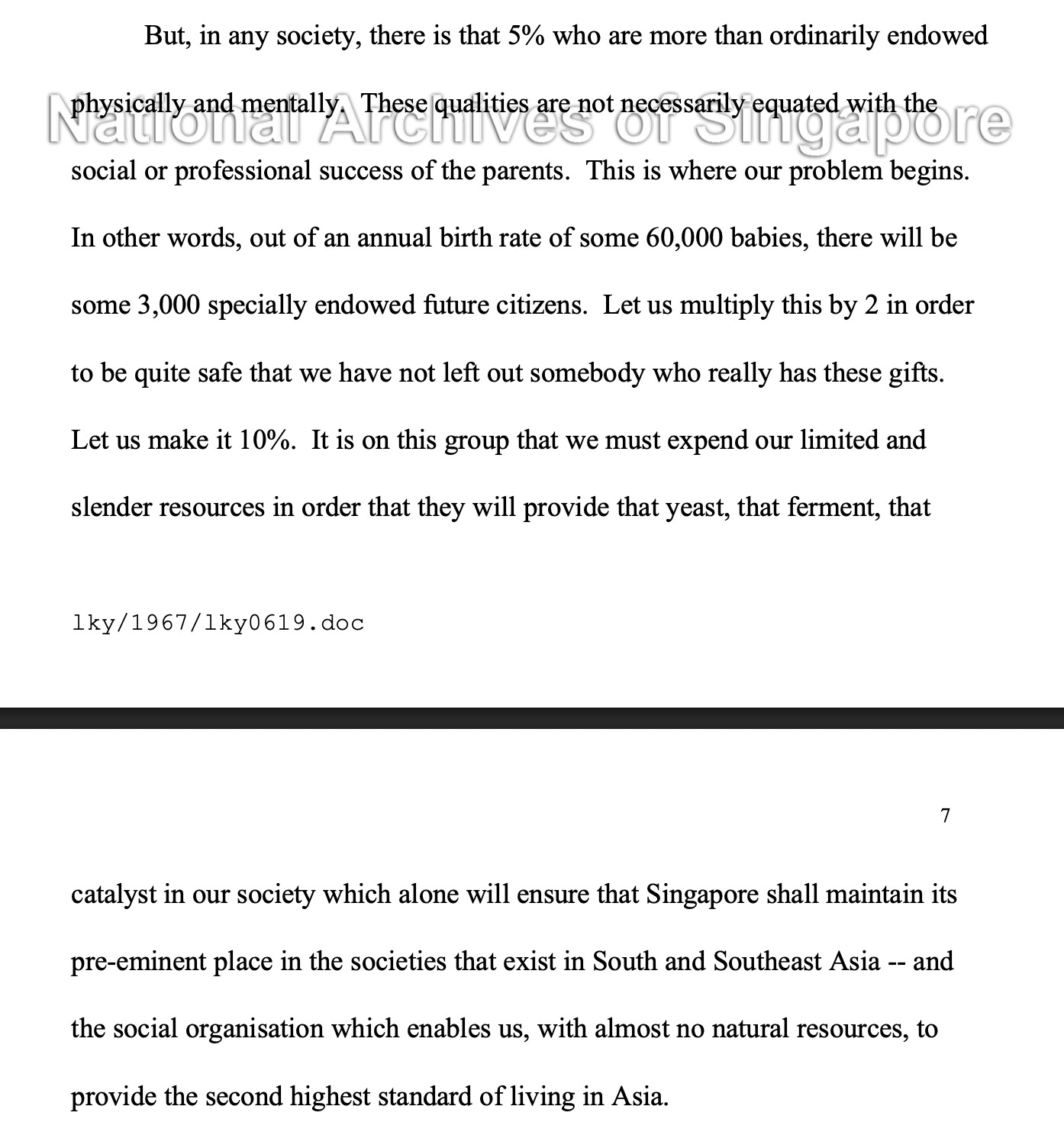
Lee Kuan Yew, June 19 1967 Adelphi hotel speech RE Convocation of University of Singapore, https://www.nas.gov.sg/archivesonline/data/pdfdoc/lky19670619.pdf
In 1969 during the Abortion Bill debate speech he claimed that subsidized housing and free education was allowing the less-gifted and less-economically-productive to outreproduce the rest, and that strong disincentives to their natality were necessary. The same year the Voluntary Sterilization Act was passed. This was followed in the 1970’s by multiple voluntary sterilization inducements directed at the poor, with preferential school access for the one or two children of poorer parents who decided thereafter to sterilize, as an incentive. At the 1983 National Day Rally LKY talked about graduate women under-reproducing, that these being left out of the “breeding pool” will produce a “more stupid society,” and complained about the less-educated women over-reproducing; saying furthermore that 80% of ability is inborn or heritable. This speech cost him and the PAP in the ensuing election—they won anyway but did much worse than expected—but LKY would not budge on such things. In 1984 children of degree-holding mothers were then given school priority access (this had to be walked back in 1985 under mass public outrage). In the same year there was a sterilization cash grant incentive: a S$10,000 housing subsidy for low-income parents without secondary qualifications who sterilized after one or two children. Also the same year, the government enacted a matchmaking program: the Social Development Unit (1984) like a Tinder for graduate singles…but there was also a separate lesser “App” for nongraduate singles, and the bifurcation of these populations, or herding into separate matchmaking spheres was the ingenuous design. In 1987 these efforts continued: “Have Three or More, If You Can Afford It,” and it included tax relief, but only for educated mothers’ third children. (And by the way it is without a doubt that primarily the Chinese-descended citizens, not the Malays or Indians, would have been the main beneficiaries of these measures). These are the kinds of things that contemporary ““““fascist”””” states like Trump’s America, Orban’s Hungary and Putin’s Russia are always accused of but have never remotely entertained, let alone enacted (nor, unfortunately, would want to enact).
This compilation of Lee Kuan Yew best moments makes for good watching, but hardly covers his statements on such things as eugenics, which to modern ears of all the things he’s done and opinions he’s held comes off as the most outrageous.
Orban versus Lee Kuan Yew, For Real
In less than one generation a swampy southeast Asian Conradian seedy port with a people who didn’t know how to use toilets transformed into a gleaming skyscraper wealthy garden city….and also happened to be the Chinese civilizational sphere’s only clean urban area that didn’t stink like a seafood restaurant garbage dumpster. This wild success story is well-known and explains why Lee Kuan Yew continues to receive good press in our time despite his open embrace of Fascist Aesthetics and Eugenics: winning is sexy. Deng Xiaoping was famously also influenced by LKY’s example (which in private LKY explained with show-and-tell eugenic reasoning: look at us and at Hong Kong to see what the Chinese race can do in commercial society once freed from Marxist orthodoxy). His success is all the more impressive given that the innate human capital of that region isn’t necessarily so impressive; it isn’t as such “high trust” at all—the Hokkien merchant of the straits was an unexpected human type for a city built on perfect mastery of logistics and guarantees against corruption. There was no history of intellectual or artistic eminence and I doubt that the city will produce anything impressive on that path for the near future. Lee Kuan Yew himself repeatedly recognized this and referred to the parvenu and peasant-migrant background of Singapore’s population, implying he had limited material to work with. It was divided by ethnic, language and confessional diversity that always carries the potential for instability, war, and interference by outside powers; it’s surrounded by bigger hostile states; it began in a crisis that involved the potential for Communist revolution. Even so, Lee Kuan Yew’s city-state averaged 8.5-9% growth for the duration of his premiership 1959-1990. It was actually double digits in the 1970’s but the average was lower because of the oil shock in that decade made it dip to 4-6% in 1974-5. From 1965 to 1990 Singapore’s economy expanded about 8x.
By contrast Orban’s Hungary averaged about 2% growth per year, with the top years 2014-2019 rising to a high of 4%, though it appears to have hit 5% maximum in 2018; the Hungarian economy expanded 40% for the duration of Orban’s rule since 2010.
You can say I’m not comparing like-to-like. Singapore started from a condition of great poverty, whereas the East European states in 1989 weren’t anywhere near as backward even after Communism (and in fact were well ahead of much of the Third World). Arguably no modern state with an advanced economy can do 9% average growth per year. But Lee Kuan Yew had significant governance challenges and foreign threats that Orban didn’t, and many other obstacles and crises besides. And in the end Orban didn’t perform as well as his neighbors, despite the fact that Hungary was especially well-placed to prosper at the end of the Cold War. Poland averaged about 3.5% for the duration of Orban’s tenure, and is a much more prosperous place than Hungary now. Hungary’s economy is one of the poorest-performing places in Europe since 2022, and inflation, maybe the worst inflation in Europe, as well as lack of investment in that country for the last few years is part of the story of why Orban lost so badly in the last election. Romania pushed ahead of Hungary in 2023. By contrast Singapore of course far outpaced its bigger, stronger neighbors for the whole of LKY’s rule.
“GDP” and “economic growth” are seen with suspicion on much of the right because these were pre-Trump GOP talking points. It felt hypocritical and stupid to see Paul Ryan types invoke this and Jack-Kemp-style language while living standards declined or stagnated and they funneled benefits to their cronies and chosen industries. Life expectancy itself was declining in America for the 2010’s, a signature metric of a nation circling the drain. So it’s worth it when you talk about economic growth and GDP in a healthy rising nation to see what it actually can mean… to look at the living standards of the people of Singapore for the 1970’s and compare it to Orban’s Hungary in the 2010’s.
If you were born in Singapore in 1965 your experience for the next 15-18 years would have been one only of constantly improving material conditions. Your family would have moved into a bigger and nicer apartment when you were 6 and probably a bigger one when you were 11 or 12. Your clothes, food, schooling, leisure activities would all have been getting nicer, with constantly improving streets, technology, and an accurate feeling that many opportunities for personal growth and wealth awaited you if you were smart and worked hard in this rising society.
This last matter of the feeling of growth and future is supremely important especially for the well-being and outlook of the intelligent and ambitious young, who themselves in turn are the group that sets the tone and character and culture of a society. Material privation in particular is pretty easy to take, and even the “relative privation” that so presses emotional triggers; but what is painful and even intolerable to the relevant cohort I’m talking about is the feeling that there is no future, that there’s no opportunity, that all prospects look like dead ends or bleak, that you’re trapped.
I’ve had friends in startups who in their first year worked 80-100 hours per week in shared apartments eating cheap Chinese takeout…but it paid off, and they had a good expectation during that period of heavy work and difficulty that it would pay off so they rather enjoyed themselves. Many employers today know this and try to hijack the startup-feel for jobs that don’t carry the same promise or rewards: I’ve seen call-center sales companies presume to have “showers” in their workplace, implying a similar workload for a very small salary with no real future potential. I consider these scams. And the GOP itself or other politicians, not to speak of the left albeit in a different way, seeing the example of places like early Singapore, or being told of this feature of human psychology, most prominent in those who are intelligent, capable and ambitious, would seek not actually to provide them with real opportunities for growth, prosperity, and freedom, but rather to hijack and scam them into hard work with no genuine expectation of rewards. I’ve had conservative older men in my limited employment experience react with outrage and wonder that I wouldn’t accept extra duties without extra pay or promise of concrete rewards. But where they miscalculate is this, that the gap between their own cunning and the intelligence of their presumed victims isn’t as big as they imagine it to be, and often doesn’t go in the direction they think; so these schemes never really work at scale.
This is part of why demands for dedication, labor and sacrifice feel like hollow shuck-and-jive in an anti-meritocratic country like the United States. If you were an intelligent and ambitious youth in 1970’s Singapore by contrast, Lee Kuan Yew’s state offered multiple paths for genuinely meritocratic advancement. From 1960 Singapore made an honest and thorough effort to rate and sort students by ability through their national examination system (the PSLE). A real cognitive-sorting exam is the best method plausibly available to modern states to advance individuals of genuine intellect, which is why the United States refuses to use such, and every day moves farther away from genuine examination (the current-day college exams are highly gamed and subject to multiple levels of corruption, which I leave for others to document). Separate tracks were implemented at ages 9 and 12 in 1979, with the further intention to identify and groom the top students. Later the state implemented an even more aggressive IQ sorting mechanism: the top 0.25-0.5% of each cohort was pulled into a separate enriched-accelerated curriculum. Lee Kuan Yew created in 1971 a modernized version of Chinese imperial mandarinate, consisting of the SAF Overseas Scholarship, added to the President’s Scholarship that had already been in force: top students of each year’s A-level results were sent to Oxbridge and the Ivies at state expense. They were then entered into the Singaporean government and fast-tracked to permanent secretary or general by their thirties. Under the “you get the government you pay for” doctrine, ministers and other high officials also had pay pegged to the top private-sector incomes (I’ve known more than one case of individuals of high ability foregoing employment in the American government because of the pay cut they’d have to take). Singapore also tried to act as Asia’s modern Athens, welcoming schoolchildren of high achievement from other states into its own pipelines, although this meant principally other Chinese from places like Hong Kong.
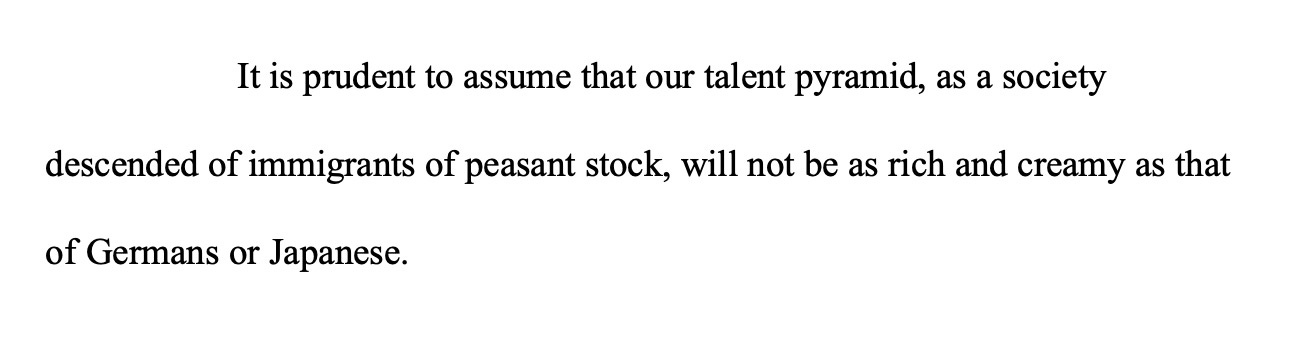
Speech by Lee Kuan Yew, July 7 1979 at opening of Singapore Polytechnic new campus on Dover Road
The above is just a brief introduction to Lee Kuan Yew’s structuring of Singapore as a “talent pyramid” and cognitive escalator: the Singapore military structure, the polytechnic and vocational school structure, all had separate selection mechanisms including IQ tests, from the 1960’s onwards. This method was refined over time to where by the mid-1980’s reproductive and pronatalist measures were directed specifically at the talented top 1%. And so an intelligent, ambitious youth of whatever socioeconomic background, who could prove himself in examinations, would experience life from 1965 onward as a series of continual improvements in his family’s station, the city’s looks and infrastructure and services, and reasonably large horizons of opportunity and advancement and wealth for himself, including state-supported scholarships at the best universities in the world (some would say this hurt Singapore in the long run because cadets brought back bad attitudes from academia in America and England, but that’s another story). Those not fast-tracked into the top layers nevertheless had less cause for bad feelings…their lives too were improving, as was their country.
The year 1979 was crucial in this respect for the whole of Singapore: in that year Lee Kuan Yew simultaneously erected several new educational-cognitive meritocratic programs and also enacted a momentous “wage correction” that lasted until 1981. The purpose of this wage correction was to kill the low-value industry and assembly economy…to eliminate most cheap-labor-dependent low-value production and force the entire economy upmarket. The entire “Chinese model” that Deng Xiaoping copied and that China itself is now shifting to depends on actually moving the economy away from producing, e.g., steel pipes, and toward high-value products and services as well as automation. Both national power and the lives of average workers are greatly improved if this is successful, as it was in Singapore. The people as a whole, and especially the top cognitive layers, experience life as a series of increasing opportunities for wealth and advancement.
The story behind Orban’s economy from 2010-26 is very different and makes the 2% per-year average growth and final years of inflation appear something much worse than mere stagnation. Orban’s legacy will have been one of brain drain, where the most intelligent and ambitious Hungarians had to leave the country; corruption, where sectors of the economy were redirected to himself and cronies for purposes of shoring up political power; and finally, the gradual transformation of the territory into a corporate slave realm. On the matter of corruption I’m not moralistic and expect that some corruption will take place in any state…but it’s one thing if you have Themistocles embezzling during a condition of bustling development and civilizational peaks, and something else if it’s a symptom of a sclerotic Cold War holdover who’s immiserating his labor force and causing the best to emigrate.
Lee Kuan Yew’s Singapore looked to the future and the development of the youth, Orban’s economy was a stagnant scheme that looked to the past and to rewarding the based factions that really stuck it to the urbanites: subsidies to rural sectors through chosen party bosses, subsidies and pandering to pensioners, contracts to chosen cronies erecting a false “national bourgeoisie” based on clientelism and patronage. Then there were the cynical media manipulation schemes at enormous expense where under a program called Megafon, “web Influencers” were herded into state social-media campaigns for Facebook boomers…outspending every political party in the EU on Meta on this astroturfed meme mess. And most of all, special tax rates and benefits to attract foreign firms, especially the German car industry and provide them with a dependable labor force.
There’s nothing wrong with attracting foreign investment and getting industry to offshore to your country. You endlessly hear now that industrialization is a great thing and deindustrialization very bad, which as such is usually true; but look at what Orban actually did to Hungary to achieve this. There was first of all the 2018 “slave law” that allowed companies to force 400 overtime hours, supposedly “voluntary” but of course very much not so when these were the sole employers in entire regions of the country…this passed with over 80% of the country opposing it. The scheme not only expanded Hungary’s long-hours-for-low pay “package” for foreign firms, but also allowed these employers to pay for these overtime hours on a three-year delay (which could also be paid back in “time off” rather than cash).
Orban presented his vision of the good life regarding such schemes in 2014, where he introduced simultaneously a concept of “illiberal democracy” (possibly cribbed from Fareed Zakaria, but with the valuation reversed, and seen holding Fukuyama’s book—he really stuck it to them!) and a “work-based society.” The “work-based society” was buttressed by a 2011 change that dropped the age of compulsory schooling from 18 to 16…in principle this is a great thing, if it means that capable and intelligent youth are groomed and selected at age 16 and accelerated into leadership and scientific-apprenticeship or technologically advanced positions. Roman patricians were certainly given international responsibilities sometimes at that age. But that’s very much not the intention of this law: it was to herd and fast-track Hungary’s youth into cheap assembly factory work for German auto firms. The vocational track of Hungarian schooling was stripped of all non-practical content and then moved from the educational ministry to the “industry and innovation ministry,” with the curriculum under direction by the Chamber of Commerce in response to employer demands. This included a dual-training track with employers themselves in the form of apprenticeships. This last wouldn’t be entirely a bad idea on its own, but all these innovative efforts went only into transforming Hungary’s less-capable youth into a dependable corporate cheap labor pool. There were no corresponding efforts for other kinds of youth, nor any upward path of hopeful development plausible for the nation as a whole. Even before 2020 I was hearing from right wing young Hungarian friends that Orban had turned Budapest into a place for corporate slaves and that they and their friends had lost all faith in him as a leader of vision or future.
The rest of the educational system was gutted, and research and development funding in general minimized to well below the levels of even neighboring East European nations. The chamber of commerce leader, given control over Hungarian education, said in the 2010’s something to the effect that the nation needed welders, not philosophers; complained about too few young skilled laborers and too many “school loafers.” Of course that in itself is an invidious and contrived polarity that says more about the intentions of the Orban regime than the potentials of a modern nation.
This is the very opposite direction of where Lee Kuan Yew took Singapore. In 1979 he raised wages to kill off low-value assembly work and move his country up the production and technological ladder. He enacted, at great difficulty to Singapore and in many ways against the nature of the place, an educational and cognitive pyramid-escalator to identify and quickly promote high innate talent. Orban did everything to turn his naturally gifted people into a cheap slave labor force. When they didn’t meet these demands, and when much of the youth chose instead to emigrate, the hero of European Immigration Restriction and Medici patron host of Eva Vlaardingerbroek, Rod Dreher, and CPAC started in 2023 a guest-laborer program that flooded the country with Filipino, Indian and Vietnamese workers. “Work-based-society” be as it do.
Throughout his tenure Orban did next to nothing to cultivate or give a path or prospects to Hungary’s own intelligent young. He inherited a national talent program from the previous government that he apparently continued, which at least is something…but had zero new offers or ideas of his own to improve the opportunities, careers or path in life of Hungary’s considerably large talented youth population. There were no programs of cognitive selection and advancement similar to what Lee Kuan Yew erected in Singapore. There was no separate track to catapult Hungary’s economy into something genuinely advanced, only an intensification of its new identity as a place of cheap labor, a labor-rentier economy.
Orban gutted Hungarian higher education, universities and severed them from the European Union’s own universities and funding. Neighboring “illiberal” Poland did no such thing, and neither did Czechia. The Hungarian state is per capita one of the last countries in Europe in research funding, behind Malta and ahead only of Bulgaria and next-door Romania—which may well have a Cold War holdover security state elite even more backwards, venal and wretched than what Orban represented. It’s one thing to say academia is corrupted and captured by leftists, and that it often engages in bad scholarship or pointless research. It’s something else to eviscerate it entirely and replace this with nothing of your own, when you control the entire state and have plenty of opportunities over many years to do so.
Orban’s only offer here was a single boutique institution, the Mathias Corvinus College, which acted as a loyalist and party cadre school. One assumes this place also occasionally catered some nice porkolt and lobster risotto for Dreher & co. and other visiting Platos and luminaries from the American Conservative Movement. I don’t know if it was these luminaries who encouraged Orban to give tax incentives and very favorable loan terms to tax-paying married families that remained in Hungary as a pro-natalist move. But this didn’t work. I suppose the “tax-paying” component of this offer is at least a minimal attempt at a proxy for quality, and should be praised. But absent other opportunities to advance in life, and actually in an atmosphere that’s hostile to talent and merit, these terms just aren’t attractive to anyone smart and capable. So they left, and the ones who stayed either didn’t deliver the desired fertility either, or….
A defender of Orban might respond that Singapore’s average age during the 1960’s and 70’s was maybe in the early 20’s. Hungary now and since Communism is unfortunately an aging society with poor fertility and not enough young people. But this isn’t a legitimate excuse for Orban’s failure. In fact this alone condemns him so much more because it means he should have fought desperately to preserve, cultivate, buttress Hungary’s most precious resource, its human capital and future. And unlike other Populists, he had managed to take the state’s institutions to an extent where he could at least have tried something. But that’s the whole failure, that he never tried. He never showed any interest whatsoever in this. His interests were to serve his preferred political factions, again, the pensioners, the rural voters in locations where the sole employers were party bosses. Others who benefited were his cronies and their clients who were to be the core of a “national bourgeoisie” through closeness to government grants, and then the foreign firms to which he lent Hungary’s youth as a cheap labor force until he decided to replace them with Cambodians.
This shameful decision to abandon Hungary’s future should be contrasted again to Lee Kuan Yew then who, by his own admission, had considerable human capital problems with a largely unintellectual and frankly illiterate “peasant population” base. Internal reports from the late 1970’s show anxiety and even desperation from Singapore’s ministers that there simply wasn’t the human material available in their nation to climb the very sound cognitive pyramid LKY had erected. (I know this goes against “HBD” orthodoxy of recent times, but most of the Chinese population groups just aren’t that bright by nature, and it shows when good-faith efforts at testing are made, let alone the civilizational scientific record of that sphere or its “achievements” over the last few decades since it’s embraced Western science.) This isn’t true for Hungary. Hungarians are very proud of the large number of eminent minds their nation has engendered, and have a right to be. Orban chose his nation as just a grim cheap-labor territory with European Union funds funneled to preferred individuals. He could have also tried to provide a well-funded and vigorous upward path for its own sizeable cohort of bright youth, proportionally bigger than what LKY had available…whether in technology, finance, high-value robotics, bioengineering, or whatever. It’s often said that big continental nations like America, India or China don’t have the luxury that Singapore does: to abandon low-value manufacturing entirely and move “upmarket” into high-value production, services and such. Maybe that’s true or maybe not, but Hungary’s population is only about 10 million, around the same size as Israel’s, which has made considerable efforts to promote science and technology startups on its territory. For example, Israel’s R&D investments are 6.3% of GDP, the highest in the world, compared to Hungary’s 1.4%. Israel promotes, buttresses, and sells its brains at world-level prices, Hungary’s offer was manual labor on the cheap. I leave for someone else a full comparison of Israel and Hungary and their trajectory 2010-26 as it would be supremely informative on its own. There are in any case many other examples of small nations who can do this. Iceland was a nation of poor fishermen until they decided to use their considerable natural endowments to become, in very recent times, rich financiers, and when that failed in 2008, extremely rich with various biotech and other innovative industries (including state of the art fishery and agriculture specialties). There’s no reason why such things wouldn’t have been possible in Hungary with vigorous and creative state incentives, which Orban was empowered to achieve.
The only plausible escalator of talent the Orban regime created was something called “TAO” and which consisted of allowances to corporations to convert otherwise taxes to donate to sports programs and sports stadium construction instead of to the national treasury. The Orban government expenditure ratio when it came to funding sports and stadiums and funding R&D and tech research was basically one-to-one. My audience maybe knows I love to post photos of athletes and that I admire physical achievement. But a regime of “jocks” is actually stupid and this ended up being mostly a way to enrich Orban’s friends. They built stadiums rather than promote national physical health or eminent physical achievement. Hungary continues to top the charts in obesity in Europe…fattest country in Europe and fourth actual country in the world behind only the United States, Mexico, and Chile (not counting the unfortunate cases of Pacific islands which contain naturally eminent specimens crushed by modern depression). 30% of Hungarians are obese, and 25% of children. The life expectancy for men is low at 72-73, a decade less than Singapore at about 81-2...it doesn’t seem like the “work-based society” is great for health or reversing life expectancy decline. Orban did try to enact a fast food tax, but this did nothing. There have been a few eminent Magyar sportsmen emerging in the last decade primarily in fencing and swimming, but disproportionate high achievement in various sports has always been the case for East Bloc sports programs generally…I’m not sure it was due to these lavish spending programs from Orban. I don’t know how this money was spent, again aside from enriching those close to his administration under the excuse of “big sports.”
Here was a man who, in the language of the post-Trump “Based” certainly “knew what time it was” and was ready to fully “exercise power.” But control and power and defeating your enemies isn’t actually a substitute for good ideas and an inspiring vision for the future. Your enemies are never quite as defeated as you think anyway. Lee Kuan Yew was a dictator but he did genuinely win majorities for many subsequent elections because the vast majority of Singaporeans benefited from his rule, had only improved lives with him, and saw only good prospects going forward. It is because of his petty vision, ideological imprisonment and reactionary resentments that Orban ended with the youth going 60%+ for his opponent in the last election, after a culturally and economically moribund 16 years—almost a generation—of his misrule.
.
Orban and American Conservatism and Populism
As regards this ideology of Orban’s I see certain very troubling parallels to the direction American conservatism has taken over the last ten to twenty years. In my article on Milei and Argentina I pointed out that nationalists should beware of Peronism, a form of “Bannonism” on steroids. It always ends one way: if the common biggest enemy is the oligarchic capitalist Fat Cat and the spoiled university brat who doesn’t want to work with his hands, why wouldn’t your allies be the salt-of-the-earth illiterate Peruvian and Bolivian working-and-believing-folk who will put their rough shoulders into hard labor and also give you demographic weight against the effete upper classes? Thus Peronist-Kirchnerist Argentina, despite its rhetoric of economic nationalism, ended up busting open its borders to Third World mass migration. So goes the policy and desire of every similar “ethnic socialist” party in Europe. In particular I remarked on the bullying, arrogant attitude that a “workers’ society” can take toward the “avocado-toast-eating college students who want to write screenplays, not work with their hands, and are possibly gay.” Always again with the added realization at some point that the Paraguayan migrant day laborer could therefore be, will inevitably be your ally against such local do-nothings, loafers and reprobates.
There’s a right-wing version of this same attitude, that’s maybe more noxious and annoying…Orban seems to have been its recent champion. If the leftist universities and the urban young are the social base of your opposition, why not get rid of them? Why not funnel youth into “the trades” and get rid of that hipster gay high-falutin cosmopolitan education stuff? If industrialization is the highest good why not turn your nation into a cheap labor rent pool, devalue your currency to become “competitive” in wage labor costs, give employers unprecedented powers over your workers (to the point where they get free loans through free labor), and cut schooling short to provide an earlier entry into this virtuous “work-based-society”? The bullying language about “welders and philosophers,” the gay loafer university crowd, the virtues of “the trades”…all of this sounds very familiar. Then finally also the Bible-banging and Pharisaic public religiosity to make up for the fact that you’re constructing a bleak work-camp society…why not also the empty tax credit “pronatalist” policies that result in nothing…very beautiful historical reenactment buildings remaking Budapest into a historical theme park (forget that the Habsburg fin de siecle style was new when the originals were built in 1870-1914 and not merely a historical reenactment but included substantial innovations at the time)…jerkoff conferences about civilizational identity…higher prices for everything and maybe a lecture from Misters Ross Douthat and Rod Dreher on how if you complain about the price of mangoes you could possibly be a degenerate selfish modernist for liking luscious tropical fruit….oh how brunch!
Did you salute your obese wife today and pray together at the community center on the way back from your job at the coal mines, anon?
Those interested in the connections between Orban’s public messaging and the American conservative movement should study the Megafon program that the Hungarian state started (with plausible deniability as an independent foundation with unclear sourcing) in 2020. It was a massively funded media push, with, again, more money spent on ads than any other party in the EU did on social media. It contrived to mimic organic online excitement through the recruitment of influencers who pandered in premade ad-agency memes to boomers and spiritual oldtroons on Facebook and such. This push precisely matches in time the changes on the American “online right” since 2022 with Elon’s X and the like promoting in my opinion similarly contrived polarities that coincide with the ossified interests of the Daily Wire and other Cable News legacy conservative fixations. I can’t speak to any operational links and I find “follow the money” analysis tedious and overdone lately, but the similarity in content is very striking…it reminds me in many vivid particulars of the conservative co-opting of the online sphere in the United States, including promotion of fake and buffoonish opposition. Regarding the Orban side, it’s instructive that once the patron and funding disappeared recently, within weeks so did this entire “online” media ecosystem of influencing in Hungary…as it wasn’t after all really akin to online organic citizen engagement, but, like much of the new online right in the United States as well, contrived Cable News 2.0
For the intellectually and morally bankrupt character of present-day debates on the right, see, e.g., this:
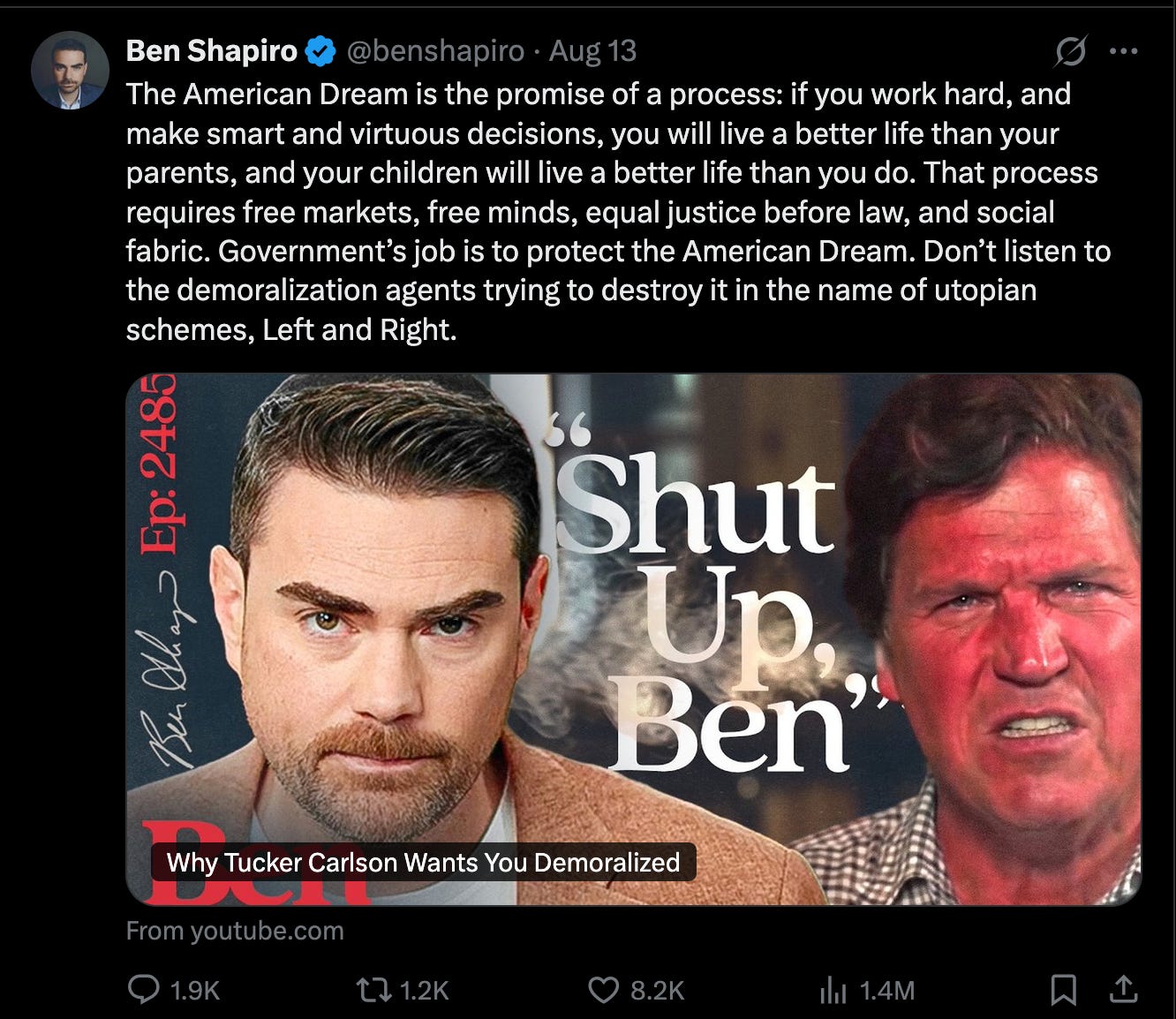
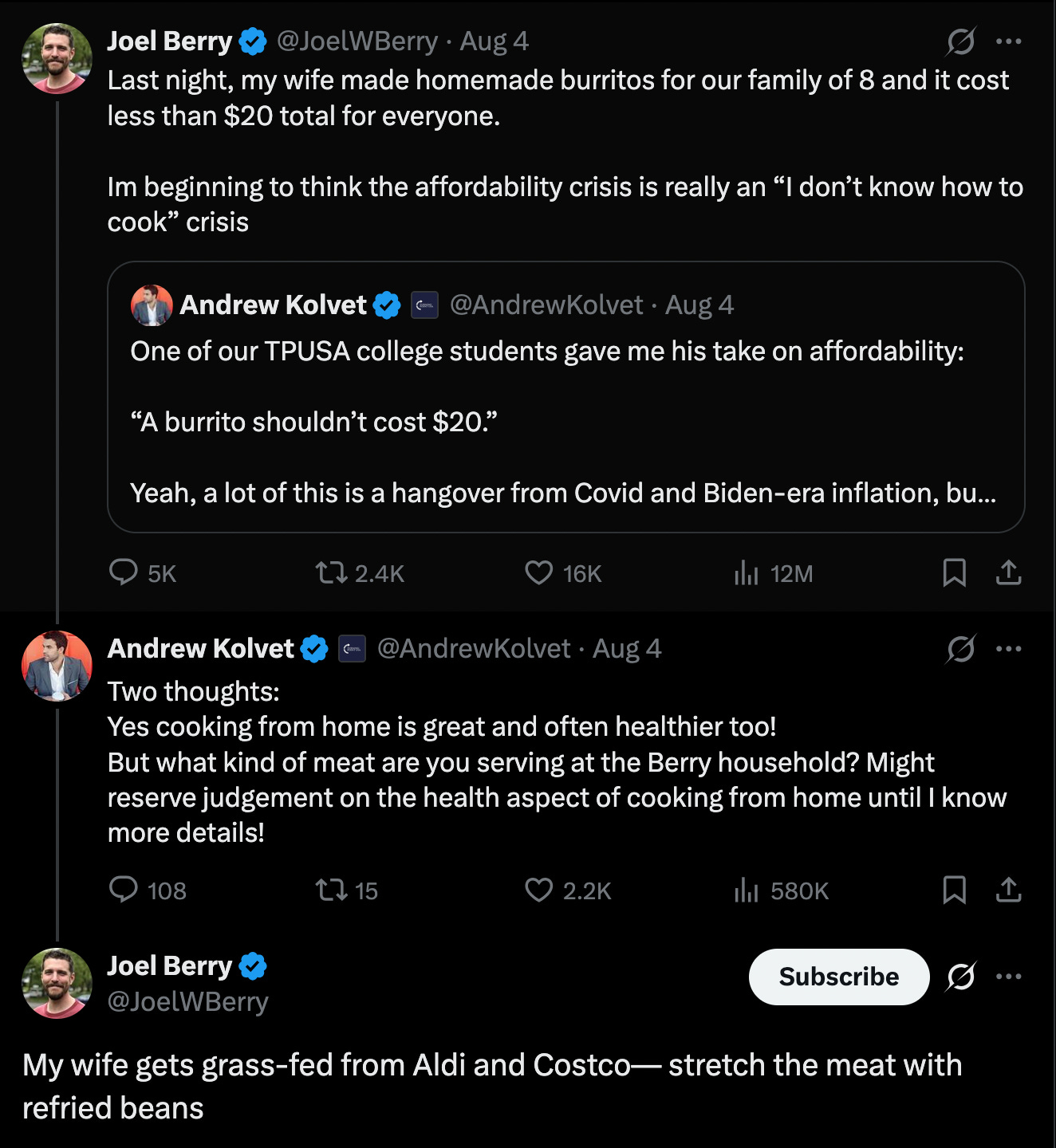
American conservatives haven’t been able to protect even the bare minimum of a liberal society, equality under the law, meritocracy and non-discrimination. Faced with a generation of intelligent and capable men who are with few exceptions shut out of advancement in life, these conservatives haven’t shown interest in fighting for the drastic changes, de facto and de jure, that would be necessary to reestablish some form of meritocracy in the United States. This is unforgivable because it’s entirely within the sphere of mainstream American feeling and ideas, both center left and right, that discrimination is unfair and merit, intelligence and hard work should be rewarded. But since the Reagan administration, whenever the right has had power, it’s made only the most anemic efforts in this direction and gave up at the sign of first resistance. You are then left by America’s 250th anniversary with absurd statements from conservatives about the “American dream” thirty or forty years out of date, and practical life suggestions to “stretch your meat with refried beans” and “work at Panda Express” as instances of the Good Life.
I’m attacking a certain kind of establishment conservative here but I suppose I’m trying to hint, through the example of Orban, that their main media opponents aren’t actually that different. The “postliberals” and similar are in a productive media engagement with the pre-Trump GOP, but offer the same hopeless future, with a different ornamentation. I’m not aware of any serious efforts on the part of Populists and Populist-Conservatives and National-Conservatives or whatever to provide a genuinely inspiring vision of the future or of good life. More concretely they don’t fight to take on America’s wretched anti-meritocratic laws, regulations, and general corporate culture, nor do they appear to have any intention of doing so. (The changes Trump would have to make here, which would include taking on Female Privilege, would cause an outcry far bigger than his opposition to migration.) As far as I can see both Ben Shapiro and Tucker, and those “in between” offer varieties of humiliation-as-success.
I don’t think the meaning of the Trump moment is fully decided. What it is, what it could be, we will see in the next few years. There are many good people in this administration or adjacent, who could inherit the leadership of the American right and take it in a progressive, technologically and economically powerful direction. In particular, the economy could be reformed with vigor and severe measures to where some of the freedoms that existed in the dynamic America of 1890-1930 would be reestablished for individuals of ambition and intelligence. The virtue of Trump was never that he’d be a savior but a disruptor and dissolver of an ossified and bleak duopoly. The Orban reinterpretation of the 2010’s is penitential aesthetics to consecrate the closure of horizons appropriate to a boomer Cold War holdover regime whose principle is the taming of youth, the sealing of life, and taxidermy: pray, weld, stay, reproduce, don’t complain about prices. It’s important I think that the example of Orban, a conservative of low vision who sacrificed the future in the name of a contrived past, be rejected. Certain measures that Lee Kuan Yew introduced could be adapted, without coercion, to the American case: versions of the honest exam, forceful action against antimeritocratic discrimination in universities and corporations de facto and not just de jure; the bonded scholarship pyramid and talent selection measures; wage and employment inducements that kill scam-work; a return as far as is possible to the laboratory of states. Pathways and opportunity for real merit could be opened up again.
Well said. The anti-meritocracy has been a quiet rot at the heart of American culture.
I'll just harp on one item - college admissions - and actually a sub-item, the SAT test.
The pre-1995 SAT was mathematically much less forgiving, and a perfect score was an incredibly rare statistical anomaly (circa 10 perfect 1600s a year nationally as of 1987). Today, a perfect score is achieved by around 7000 students a year rather than a handful. (Yes there are more test takers now, but now 0.4% of students get a perfect 1600, vs <0.001% in 1987)
In 1995, the scores were "reweighted" and the precision of top scores was effectively destroyed. What was once a razor-sharp instrument designed to identify extraordinary mathematical and verbal reasoning became a blunt tool, artificially compressing the right tail of the bell curve.
This is not really about the perfect scorers, but the loss of granularity. Before 1995, a score of 750 on the math section signaled a fundamentally different tier of cognitive abstraction than a 700. The test has stopped doing its primary job: differentiating talent at the absolute highest level.
We replaced a meritocratic ladder with a gated community. Of course the 'left' wanted this change so they could focus even more on 'holistic' admissions - eg group preferences - but in general all society went along with the situation - there is also a measure of corruption in that those parents with sufficient 'social capital' were happy with this change as well. I'm not even making an argument against a bit of an 'aristocratic' tinge at the top universities in regards to admissions - but we already have legacy and athletic admissions for that. We need the granularity of admissions testing back.
Good essay.
A couple of comments:
"In fact, 19th-century liberalism is in many cases synonymous with nationalist projects, such as the unification of Germany and Italy." - True as that may be, certain ideas and myths harbor a latent seed of destruction that only bears fruit when conditions become favorable. Consider how Christianity, though once invigorated by a pagan ethos that enabled Europe to flourish, nonetheless carried the nascent seeds of the decay we observe today. Probably, liberalism also carries such a seed.
Regarding "manual workers": Europe also needs people who are less inclined toward intellectual work. Perhaps with AI this will eventually become largely redundant, but it was certainly still important under Orbán. There are two solutions to this: either a society "produces" these people itself, or it has to import them, because, like it or not, it’s not possible to live solely on engineers, philosophers and artists.
I agree with the assessment that conservative American influences have somewhat shaped Orbán’s latest strategy and positions, which has been largely harmful to european right-wing movements. This even had some farcical moments like the most recent CPAC event in Hungary in March of this year, which opened with the American national anthem, to the astonishment of many of the European nationalists in attendance.