
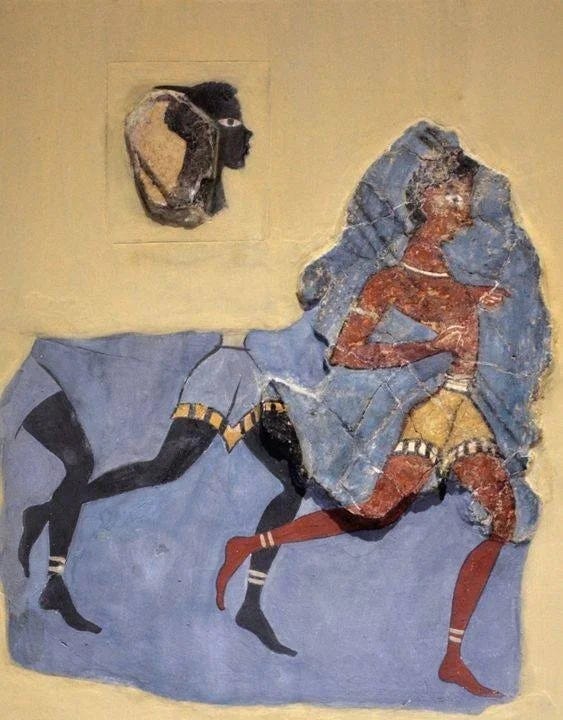
Chris Nolan’s Odyssey is a pedantic movie undeserving of a serious intellectual, ideological or aesthetic review. But most of its right wing critics who try to claim it is simply a “woke” film are wrong and misguided. It’s woke in the same way mainstream conservatism in America and England became woke under Bush and the Tories. This doesn’t make it any better than if it were the far leftist agitprop its critics imagine it to be. It fails primarily as art for deficiencies of plot, character, and aesthetics, but in this clumsiness is included the great error of all didactic art, that it’s a forced homily-allegory for its own time. It speaks to Nolan’s narrowness as tedious commentary of the type that might be at home now in the social spheres that supported George Bush II and Karl Rove, or at least Christopher Hitchens. As the movie is unworthy of detailed reflection itself, I’m writing this to address various other tangents that interest me and also the controversy it generated.
Nolan’s Odyssey is a failure on multiple levels that have nothing to do with politics and that make it a liability to any views it supposedly “supports”: worst of all is the leaden artificial dialogue that is almost surely written by LLM. I was astounded to see for this director uncharacteristically here very much a “tell, don’t show” exposition style where characters basically face the camera to transmit their awareness on their own “historical age” as explained in academic books written thousands of years later, and which Nolan wants the viewer to see he dutifully read. He’s beating a probably ignorant audience over the head with very explicit Baby’s First Ancient History Educational hour. I generally like Nolan and think he’s a lot like Hitchcock in the sense he has an appreciation for narrative as mere visual excitement; he also has a similar attraction to dark mystery feel. In North by Northwest Hitchcock takes this tendency to an absurd limit, where the plot is rather ridiculous and the mystery is as usual a let-down and a nothing…but it doesn’t matter because the whole movie is an occasion for visually thrilling vignettes that have remained iconic decades later. I thought Nolan was very enjoyable in similar way in the Batman films, especially the first, and in Inception, which in moments carries some of the rush you get talking to real schizophrenics; his first American movie Memento is also good and manages to sustain an immersive mood of mystery and obsession. He hasn’t followed up here, although the story invites it and he could have made something very successful merely by showing the adventure stories of the Odyssey in greater detail.
Nolan’s concerns about justice and morality in his previous movies were artist’s vices incidental to his films, easy to ignore, and unnecessary to enjoy them…but he seems to have indulged these faults in his latest movie at the expense of what he’s actually good at. It’s possible he and Ridley Scott, maker of two recent execrable and actually-more-aggressively-woke movies, are co-students in the arts of chastity at the prodding of their wives (or whoever). There are just a few scenes on Odysseus’ exotic travels where Nolan is obviously truly enjoying himself, but he cuts it short just as it gets good. The Cyclops scene is almost perfect and the best of any on film so far. That’s what’s frustrating, because this could have been a great movie…all he had to do is just more of that. On two occasions, in the run-up to the events in the Cyclops cave, and in the ascent to Circe’s house, Nolan shows his special taste for Mediterranean biome and mystery feel, which he’s obviously relishing as something new for him on film…he should have just gone with this. Unfortunately instead of continuing to do what he likes and what he’s good at, Nolan kills these instincts in himself, doesn’t linger on such scenes…he denies himself and the audience this pleasure in order to inform you that he’s Really Concerned about Certain Serious and Political things in our world, and also that he’s very sensitive to the dignities of his wife and daughter. You can see him on several occasions caught up in his own orgasm-denial.
The other visual and “literary” aspects of the movie are very mixed. I found the many complaints from others about the coloring to be wrong: some scenes are vivid, colorful and beautiful, especially at sea. But the framing for IMAX doesn’t work if you see it in a normal cinema. The ending battle scene is unoriginal and a failure…as friend put it: “The ending is Kill Bill by torchlight, you never see a blow connect, just a blur, all of it closeup and medium. Also the editing is bad, hyperactive. It cuts from face to face every half second — this is how it is in every film now.” In visuals and dialogues this movie often trips on itself.
Self-conscious clunkiness and stumbling were also the problems with many recent historical epics, like Troy of 2004 and Oliver Stone’s Alexander. In Troy they got rid of the gods altogether and replaced Homer’s dreamy and alien world with a coarse and very-contemporary Realpolitik discourse. They took out all the poetic enchantment and adventure and plopped in the facile cynicism of college student “Geopolitics” piledriving sessions. Nolan does this too, having Odysseus intone darkly about Agamemnon’s wish to “control trade routes.” It’s Rand Corp briefs-policy-wonk-language of a man who has a bad conscience he doesn’t work in an office, instead of the sustained spell that this extremely romantic epic could always cast over someone who really loved the tales themselves.
On the other hand, the common complaints about Odysseus being wrongly portrayed by Nolan as inner-conflicted and brooding are also way off. Homer describes him many times as weeping, many-troubled and he’s at times treated as an outcast by others when they realize the gods hate him. He describes himself as comparably the unluckiest man. Gods also joke or pun about him in this same way, and he was seen in the ancient world also as a man of high troubles who must endure many evils. In Homer Odysseus doesn’t seem to have a lot of joyful amor fati about it either…he refers often to his own travails and misery, although he’s arguably not pestered by anything like modern guilt.
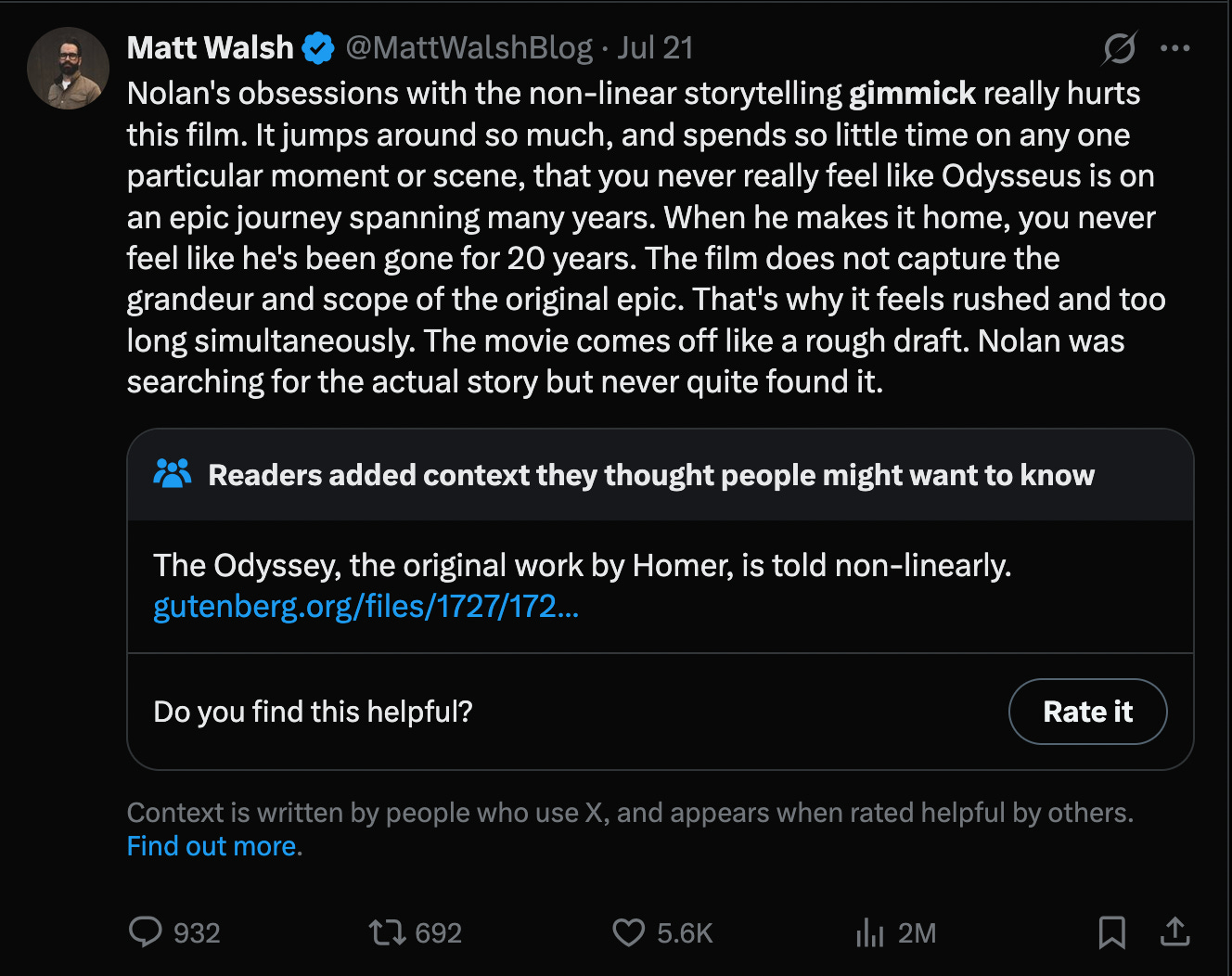
Most repulsive is the conservative commentary complaining about the literary “nonlinear” narrative of Nolan’s movie. What I hate most is this absolute ignorance of Walsh and others who think the film is some kind of dazzling experiment in newfangled hifalutin art gallery 3deep5you, and not good plain honest story tellin’. Homer was just a plain dealing folksy campfire story teller. What is “in medias res?” Why do I need to be “disoriented”? That’s unamerican. Joseph Conrad was also a woke hipster bullshit artist for telling highly irregular nested storylines that “jump around” too much, you see…
The controversy around this movie will be remembered more than the movie itself. The right broadly speaking, and for example Elon Musk and Matt Walsh, reject the movie instinctively because they believe the casting is motivated by the Woke desire to besmirch Western civilization, and to replace its historical heroes with those of different races. They feel this is done in order maybe to promote a kind of literary “DEI”-affirmative-action retroactively, or maybe to justify mass migration. I say instinctively because it can’t be based on having watched the movie; if you see it, this is obviously not Nolan’s intention. I myself went in expecting to be lectured at on those lines, but there’s nothing of this. Nolan obviously cares about and loves his source material, unlike Ridley Scott whose recent Napoleon and The Last Duel were both composed entirely in the spirit of butthurt and bitter opposition toward his subjects. The casting doesn’t feel motivated by what people are suspecting, isn’t emphasized on political lines at all, and I didn’t even get the sense he was trying to retcon the ancient Mediterranean as diverse (more on the actual history of this in a moment).
Ellen “Elliott Rodgers” Page’s casting as a literal male ghost devoid of life-force without the sipping of sacrificial blood is appropriate; when Odysseus speaks to her in the underworld she actually does come off as uncanny ghostlike wraith male shade, mouth smeared with blood and a raspy delivery that would have been too frightening on a biological male. I don’t understand what the complaint is here, and maybe I’d expect the complaint to come from the trannie-world instead, as typecasting them.
I laughed out loud when Menelaus, who plays Black Helen’s chud husband stand-in apparently for Andrew Tate-Donald Trump hybrid, says in a coarse New York-tinged accent tough guy growl “Look at dat! Da face dat lawunched a tousand chips!”…following this, the audience sees “a ghastly pitch-black witch doctor rolling her eyes around like Stepin Fetchit.” Helen has scarification of the Omo Ethiopians. I don’t know what the intention here was—I suspect it was Nolan cleverly trying to solve the problem of how you could ever cast one of the most beautiful women in history, and resolving at least to choose a face that would have been so out-of-place and distinctive in that world that it could have left a mark in myth (the very bad Troy of 2004 casts a conventionally attractive but unremarkable lady you could have found in the mid-2000’s at any bar or restaurant in Santa Monica waiting tables). But the effect on the viewer is that Lupita is being trolled and black women are being trolled. I think Nyongy’o was the wrong choice for this role anyway. She is Kenyan and maybe Bantu and has a rather plain American-black-woman face…and at least in this movie a clumsy and goatlike bearing. If Nolan wanted to do what I said in this paragraph regarding casting, he could have chosen a genuine alien-looking Nilotic beauty like Anok Yai. (I think his failure to do so isn’t incidental but again a result of deliberate moralistic self-denial.)

The most obvious and cynical interpretation of Nolan’s casting choices is that he knew it would make Elon and his website get triggered, generate media controversy, and increase sales. The right then yet again acts as guerrilla marketing for the left, and in this exchange loses entirely. I’d bet that pretty much any viewer who goes into this film won’t feel he was lectured on race and ethnic identity in ways claimed by the right (you do certainly get lectured, and in very clumsy ways, but not on this). Very few people in any case identify with the heroes of Homer today as the origin of their civilization, let alone their ethnic identity or peoplehood. Far more often you hear from the religious that the mean and masculinist pagan godless heroes of the Greco-Roman world were given a stern and effective moral talking-to by the Books and Wisdom of Israel. The “online right” then appears in its complaints out of touch, oversensitive and paranoid.
An example is my otherwise friend Steve Sailer who I feel has made several mistakes in his messaging on this. Here are some of his tweets, a couple of which I retweeted before seeing the movie myself:

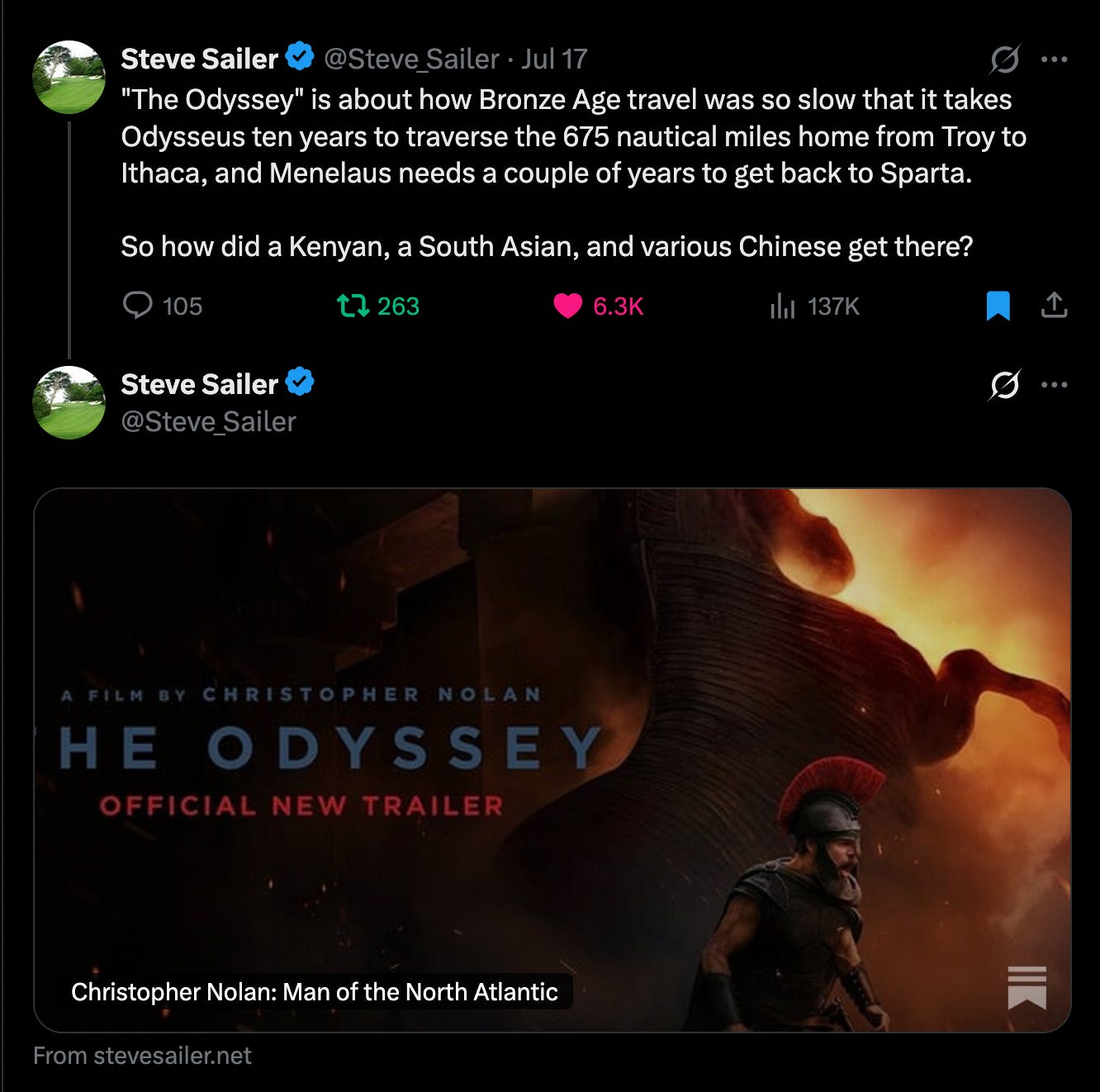
Here Sailer sounds plausibly right but is just wrong, for reasons I will now list. Let me say first that I do in the end think the casting by Nolan is stupid, ahistorical, and politically-motivated (although not in typical campus left “woke” way or for the same reasons an actually woke academic like Emily Wilson would cast the movie the same ways). Nevertheless, it’s just not true that Bronze Age royal courts would have been ethnically homogenous. They would also not have been representatives ethnically or racially of the people they ruled; it’s also not true at all that they would have had no guests or employees of other and possibly weird races. The fact that the Odyssey is partly a story about the dangers of sea travel is true, but another big part of the story Sailer leaves out is that Odysseus is uniquely hated by Poseidon. I posted recently a series of sayings from classical Greece—admittedly many centuries later with maybe better naval technology (although naval travel times stayed remarkably stable in the Mediterranean from antiquity to semi-modern times) comparing the failure rate of sea voyages to failure rate of marriages; from Athenaeus:
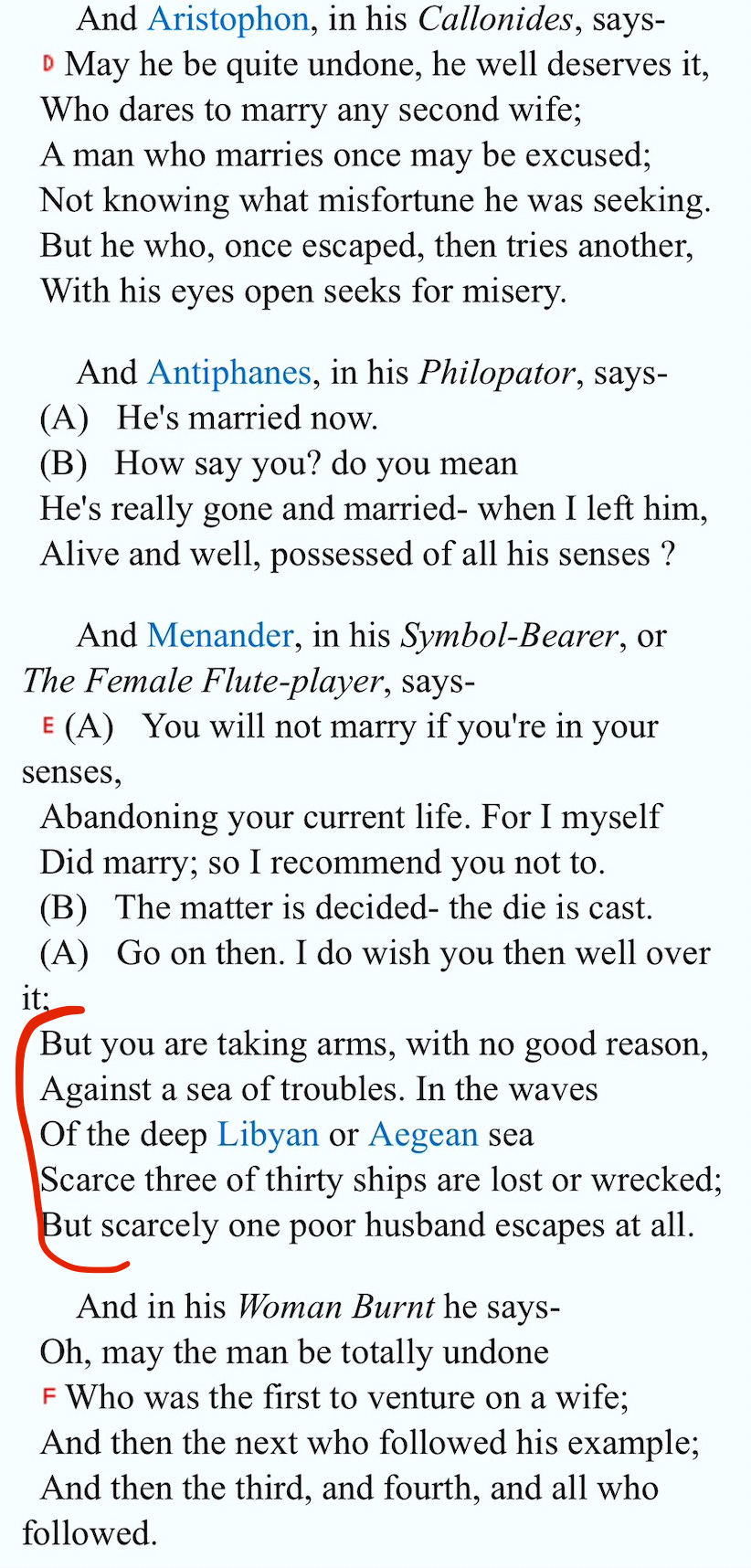
That’s a one-in-ten failure rate and maybe at the high end: there are speeches by Demosthenes also where naval voyage insurance contracts are described, and some have tried to reason back from that…and voyages were dangerous but not as dangerous as Sailer implies basing his claim on the unique examples of Odysseus’ troubles. Obviously Greeks built colonies all around the Mediterranean and Black Sea, and many were around people who probably didn’t look like them.
Indeed sea travel was very dangerous always…but on the very stormy Pacific, the Austronesians managed to colonize vast areas with stone age technology. These areas were populated by their descendants as mixed with racially-very-different Melanesians, and in the other directions, in Madagascar, with Africans; and in southeast Asia with all kinds of others. This was achieved by stone age peoples. In a recent episode of my show “Caribbean Rhythms,” I repeated Robert Drews’ very interesting idea that the Aryans arrived in India by sea, from roughly present-day Basra, after a sojourn in Mesopotamia. Whether that’s true or not, if that event did take place—not too long before the events shown in the Odyssey—it would have been a resuscitation of an indisputably real, then-dormant, but much older sea-path…some think the Harappan Indus Valley civilization may have been founded by Sumerians or such. They at least had heavy influence from a transplanted elite that had arrived by sea from Mesopotamia, and that sea route was known and indisputably active very long before the events shown in the Odyssey. It’s becoming ever more clear that sea, river and ocean travel always was by far the preferred mode for ancient humans. Despite the dangers, it’s much easier, safer and faster than overland travel, though it does require a certain intrepid character and some special intelligence. (A “computer AI” should really map out all the “easy” sea currents from likely launching posts in all coastlines, and likely plausible landing places, as I think this way we might discover previously unknown “connections.”).
When it comes to the Bronze Age Greeks themselves, I hold again to Drews’ theory that they arrived on the Greek mainland by sea from the Caucasus in the Middle Bronze Age, as an introgressive small military elite. Prior to this during the Minoan Thalassocracy of the early Bronze Age, centuries before the events depicted in the Odyssey, the regime at Knossos certainly did enlist mercenaries from the Caucasus to police their holdings and mines and vassal populations on the Greek mainland: the new “suite” of military technology including unique types of rapiers and especially the chariot warfare that was to be the foundation of the power of Bronze Age monarchies was a specialty of these mercenaries who came from very far away. These mercs in employ of the Minoan kings would have been very likely a quite different race from the locals as they hailed from the Trialeti cultural area, which was itself related to Catacombs Culture, and in turn both related to Yamnaya. The “basketball theory” of Aryan dispersals is funny in this regard, in that tombs in that area of the Caucasus around that time have yielded individuals of heights at 6’7 and 6’9; the earliest known Greek skeletons at Mycenae Grave Circle B are big…larger and different-built than the surrounding contemporary population, and present phenotypic differentiation consistent with genetic difference (the Greek government is so far forbidding detailed genetic testing of these Shaft Grave remains for obviously petty political reasons, and no one seems to care). In their tombs they have unique “wave-pattern” (swastika) designs that were only found otherwise in that same style very, very far away in the middle of the great steppe way north of the Caucasus (farther away and more remote from Greece than e.g., Nilotic Nubia). For a connoisseur of Indo-European dispersals, Sailer’s et al claims that racial heterogeneity was unusual to the Bronze Age courts (and before) is bizarre. And even if you were to dismiss my admittedly minority claims about Greek origins here by the way, the presence of southern-Caucasus mercenaries in the employ of the earlier Minoans is much more certain…and again, they would have sailed in from much farther away and on a much more hostile body of water than Odysseus experiences—the Black Sea is frightfully stormy and dangerous. Regardless, such voyages were routinely made with full certainty in historical times with similar naval technology.
Part of the material basis of the Bronze Age itself was tin mining, a specialty of the Phoenicians, who in order to mine this relatively hard-to-find metal had trading outposts as far away as north Europe and northern England, Spain and beyond…and who knows where else including most probably way down the coast of west Africa. At the height of Bronze Age monarchies in the Near East and among the Mycenaeans, there most probably would have been Nordic mercenaries, steppe mercenaries, and yes, subsaharan African mercenaries present in numbers substantial enough to leave a pictorial and other record and to enter in lore.


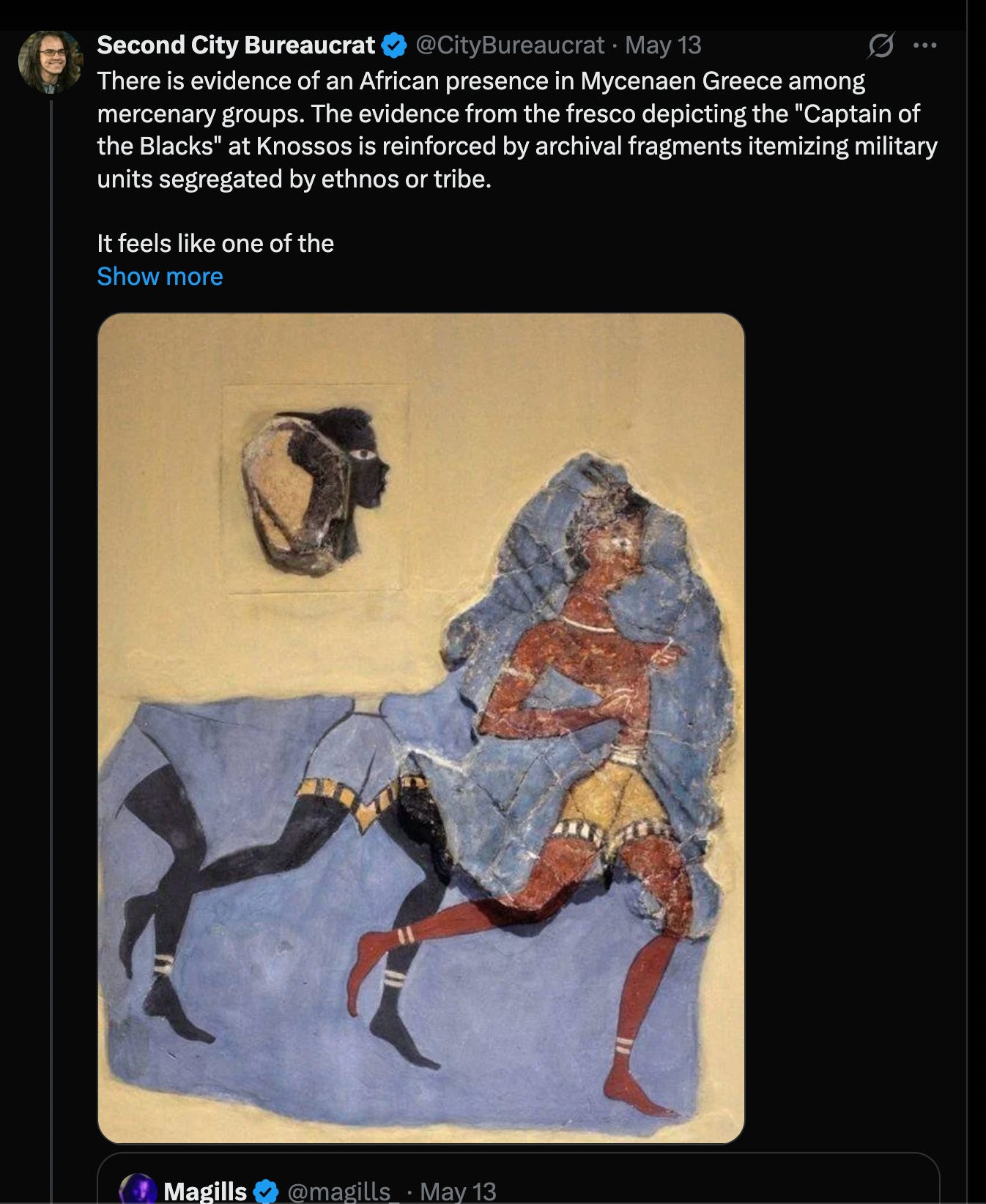
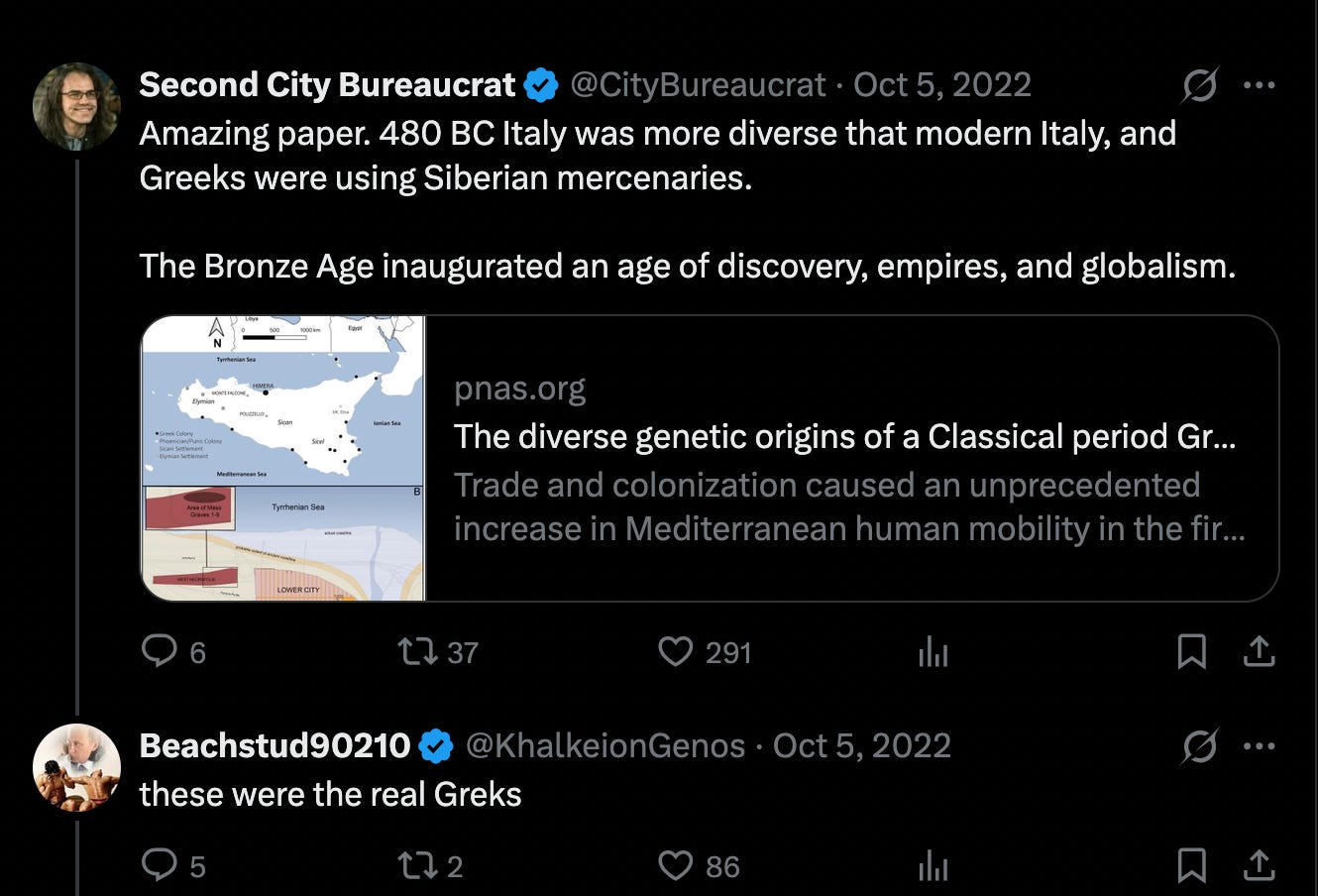
I would guess there would have been also occasional intermarriage with such “guests,” especially if they had elite status. Bronze Age society didn’t have a concept of nationhood in the modern sense of the nation-state—that’s arguably an Iron Age defensive development in response to the mass breakdown the beginnings of which you see clumsily depicted in Nolan’s Odyssey. Often as among the Hittites, the ruling class was certainly racially heterogenous from those they ruled and had no common concept of peoplehood with them…in the Hittite case they called themselves the Neshites and their language Neshili; and ruled “the people of Hatti,” which were a heterogenous patchwork named after the land, not their tribal identities. They had separate gods, traditions, and identities from the patchwork they ruled. Bronze Age monarchs regularly sought alliances and spouses from their counterparts in kingdoms very far away, with whom “they kept a lively correspondence,” as apparent in the Amarna letters. Nolan isn’t inventing the fact that it’s the first (known) interconnected, international civilization. Their inclusivity wasn’t based on modern ideas of tolerance. But to believe, e.g., that a Mycenaean or Mitanni king would have had “racial loyalty” to the people or peoples he was ruling, or saw himself as racially or ethnically related to them, is a bizarre and ahistorical conceit, as is in my opinion to insist that his court would have looked “ethnonationalist” (the later Jews themselves were in my opinion very much a heterogenous, even wildly heterogenous patchwork, and the Bible falsified only in post-Hellenistic post-Maccabean times a common national story). The Sea Peoples got their start precisely as mercenaries at the great Bronze Age courts. They were auxiliaries to the chariot tanks—the Sherden (or Sardinians?) at the court of the Pharaoh, who later attacked him. They didn’t look like the Egyptians.
Those complaining about a black queen may be forgetting that the wisest man in the Bible and supposedly the wisest in the world—though a thorough comparison of his wisdom with the sages of the Greeks has only been hinted at by some—Solomon, had a wife or consort or such that probably looked not very different from Lupita Nyong’yo. I know Sheba was “Ethiopian” but that meant sometimes something different in the ancient world: when Herodotus extols “Ethiopians” at Histories in Book 3 as the tallest, physically beautiful men and spiritual kindred of the Greeks in their opposition to Persian imperialism, these were obviously Nuba- or Dinka-similar Nilotics of some type. (It’s funny that, like Odysseus, the Nilotic/ “Ethiopian” king Herodotus describes presents a bow that only he and his men have the strength to string as a challenge to the Persian envoys to take back to their king.)
This is something else many miss in the “race incorrect” criticism of Nolan’s Odyssey. The Greeks uniquely had a wild taste for the foreign and the exotic, and the Odyssey is one of their earliest and strongest statements for this bent. Odysseus is admired in the opening lines as a man who saw the lands, cities, customs and hearts of many different peoples (this is largely in my opinion why Emily Wilson wanted to translate polytropon as touched with the meaning of “problematic,” according to a recent interview of hers, because in the modern leftist/“woke” understanding, it is the colonial and exploratory aspect of European or white man that is the greatest sin, and that must be provincialized; it is his observation, exploration and classification of others that is intolerable to them, for it makes him a historical center of progress. And wokeness is fundamentally a reactionary movement against freedom and progress). It is actually remarkable that the equivalent of the Bible for the Greeks would look with relish and admiration on such adventures. It’s a taste for exploration, for the foreign and unusual and away-from-home that’s transmitted to Herodotus and others later and arguably bequeathed, by twists and turns, to the European west as a whole.
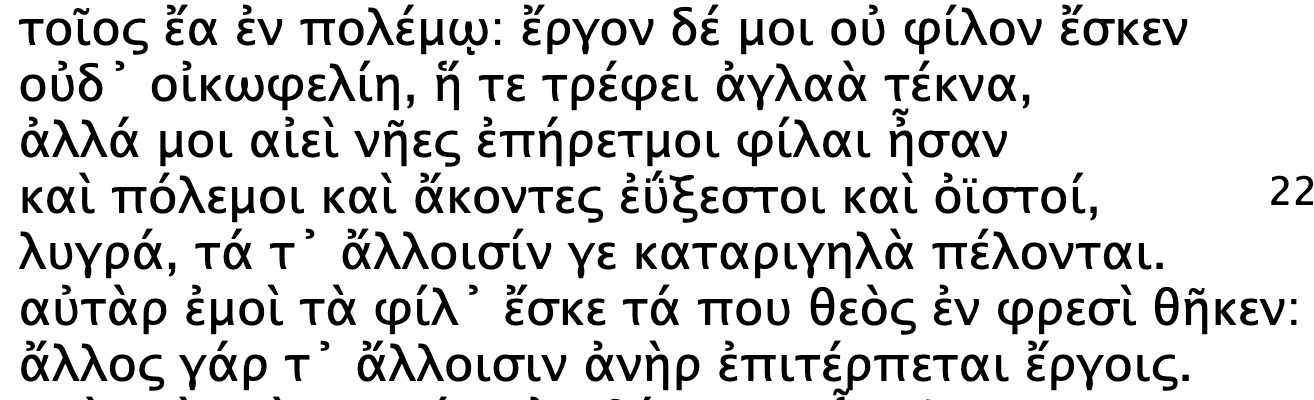
I was so in war; but work was never loved by me,
nor care of the household, which rears gleaming children,
but to me always loved were oared ships,
and wars, and well-polished spears and arrows:…
(Odyssey 14.222…)
This is part of what made both the Greeks and the Europeans who shared this sensibility truly unique and I claim it is one of the emotive roots for freedom of thought and for philosophy and science also. In book Occidentalism you see instead the total lack of curiosity that other civilizations had about foreign customs and peoples. Gobineau emphasizes that ethnic parochialism is one of the main distinguishing marks of non-European peoples (and one of the markers of their spiritual and intellectual inferiority according to his criteria). This doesn’t mean that integration and equality as per modern models was practiced in the ancient world, or that such things inevitably result from outward-looking, exploratory attitudes, or that Nolan’s casting is legitimate or not politically motivated. It does mean that the premise of the online “right wing” attack on Nolan, that he errs for showing “diversity” in the context of Bronze Age courts because obviously they all practiced ethnic nationalism or because sea travel made different human types-transfer impossible before the age of planes…that these things are not just factually wrong, but misunderstandings both of Bronze Age monarchies and of what makes the spirit of the Odyssey itself unique.
(Genetic studies certainly do tell a story about the mass of ancient populations, which in general never really moved places. Most of the stories we have now from remote antiquity about migrations—the story of Exodus, for example, bear no relationship to the local archaeological record, which shows continuous settlement by the same populations, but were the charter myths of introgressive or symbiotic-dominant elites. These certainly could be captured in genetic studies if the fortuitous finds are approached: interesting would be mid-Bronze Age Levantine kinglets with obvious Aryan names analogous to what’s found in the Vedas…not Vedic, but preserving Proto-Indo-Aryan archaisms…e.g., Indaruta ruler of Achshaph, among quite a few others…but no bones found yet, etc., and this doesn’t show up at all in the mass population of the time and place.)
Helen herself probably shouldn’t have been cast as a subsaharan black, but in principle there’s nothing wrong with Nolan having a “diverse” cast in this movie…the problem isn’t this, but why and how he did it. He should have relished in the exoticism and somehow visually explained the presence of foreigners at these courts. He could have really dwelled on it actually, and explored the way these people would have been appreciated as exotic imports and specimens with their own separate rituals. In historical times in classical Athens there were according to Herodotus still prominent families of Phoenician descent with their own private home cults…there are film-makers who glory in displaying such things, e.g., Werner Herzog in Cobra Verde, where ethnographic and cultic oddities are visually enjoyed…python dances, or what. Film is the perfect form to enjoy this kind of “diversity.” That love for weirdness would have been a lot more interesting, and he could have indulged his taste for the uncanny and horrific: what he did instead actually comes off as defensive and boring. He plops in some foreigners with no context and gives the impression he is pandering to an American audience, to “make his cast look like the country” (a grimy terminal at DFW airport…with actors from Los Angeles, who act like white Angeleno actors of the 2020’s).
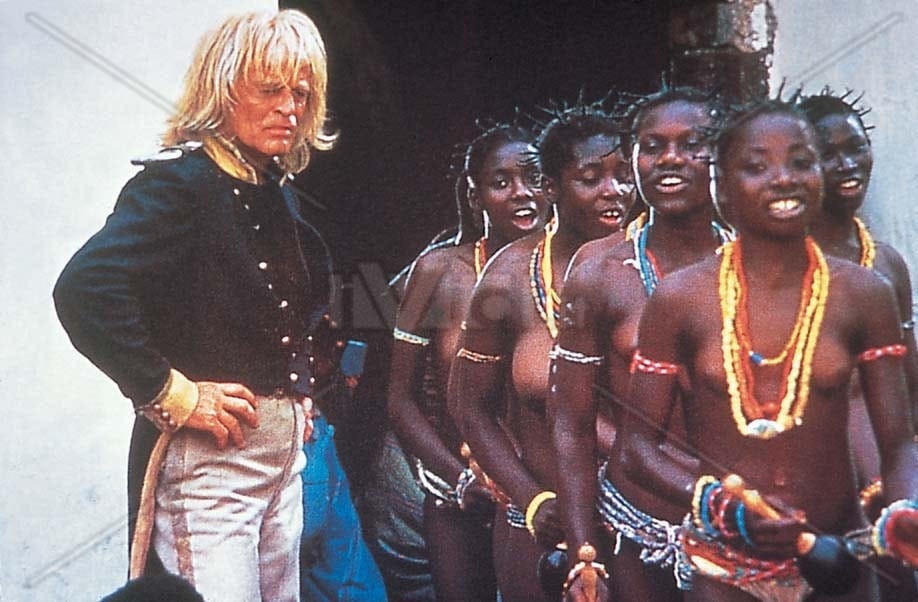
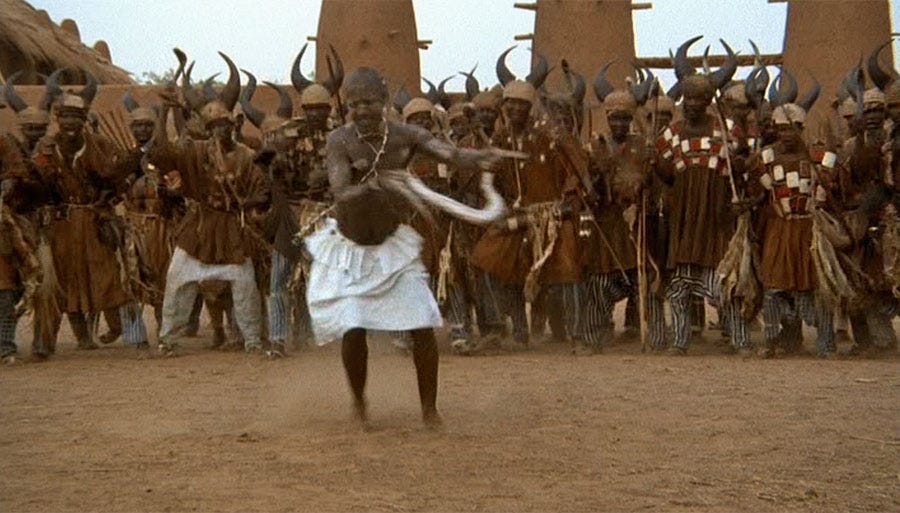
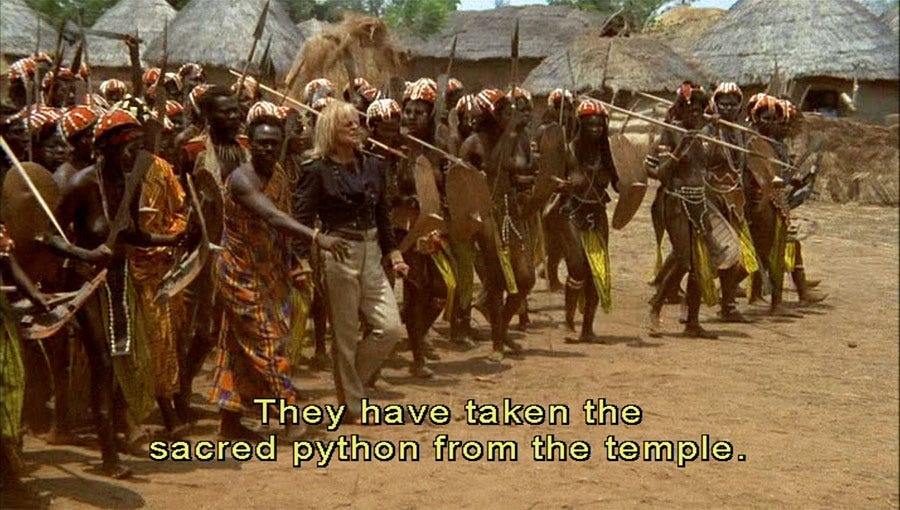
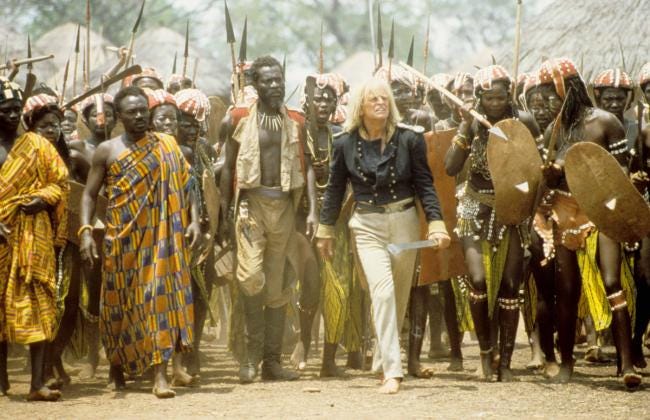
Klaus Kinski in Werner Herzog’s Cobra Verde 1987
In Emily Wilson’s recent review this is actually the aspect of the casting that she complains about: she feels that Nolan was too fetishistic and tokenist in his casting, that is, that he besmirched the actual principles of wokeness she holds to. As the “online right” is now largely senile and unable to read beyond 500 words, and has no knowledge of how the Woke and the New Left see themselves and what they believe, they celebrated Wilson for her “slamming” of the Nolan, who has been declared the week’s public Bad Guy #1. That they are willing to admire and celebrate a review that attacks him for not being woke enough is more evidence this “sphere,” whatever it may have been, has completely lost the plot and sunk into the irrelevance of an incoherent seal-clap gallery. This is an inner dispute among different liberal-left factions that could be exploited by “the right,” but is being mishandled.
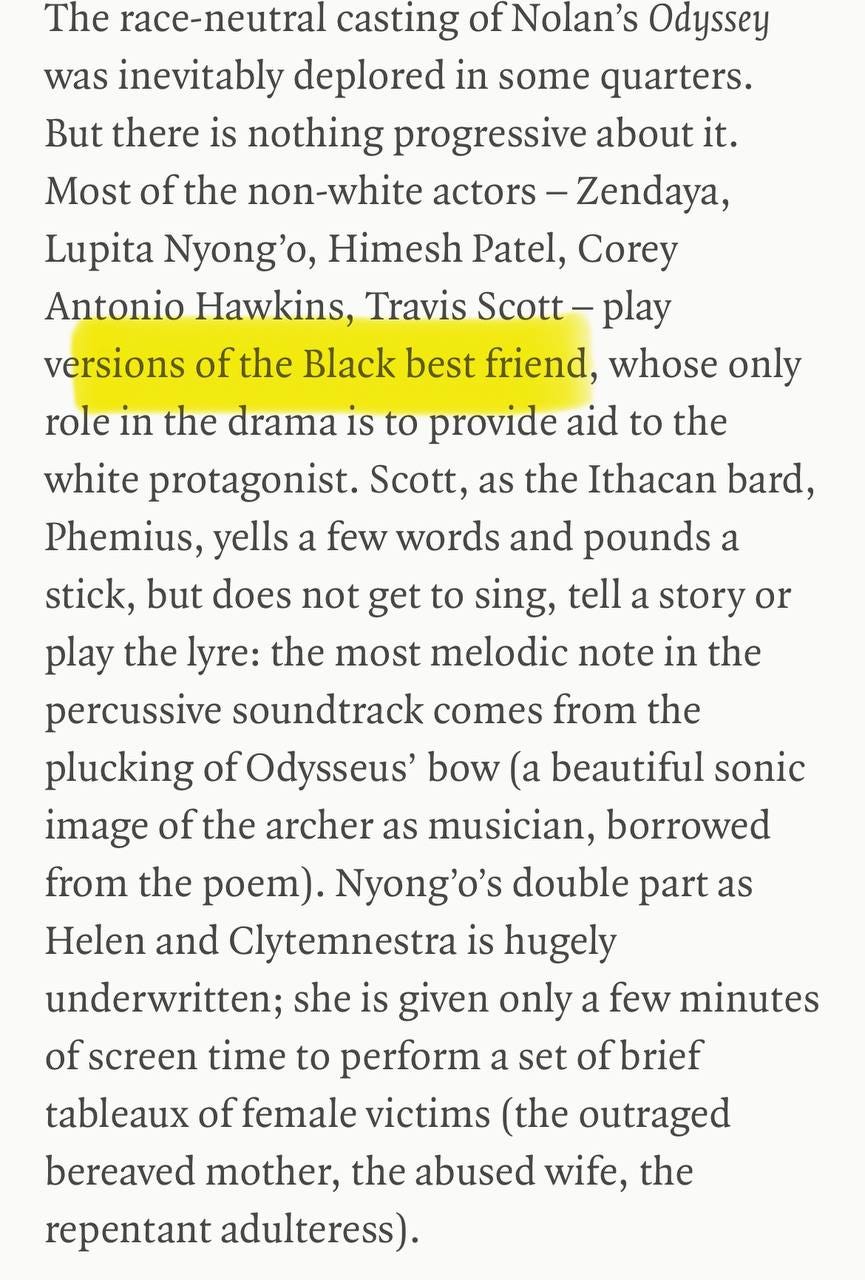
Which brings me to Nolan’s actual political program in the Odyssey. Strange there should be at all a debate about this when he has characters look at the camera and explicitly verbalize it on multiple occasions. Nolan’s view is that the Bronze Age was analogous to ours in that it was a relatively international, relatively racially inclusive prosperous time based on global commerce. He also believes there was a moral-legal element as the basis for all this: he thinks the guest-host relationship was a rough precursor of the “postwar international order” and its own ethos of human rights or international law. He believes transgressions of this reciprocal ethical system in the forms primarily of warfare, covetousness, and abuse of hospitality led to the collapse of this civilization and the start of a new dark age. He openly references this new dark age at the end of the movie.
Over one third of screen time consists of the depredations of caricaturish-evil suitors. This is a lurid revenge-redemption story against their many offenses. This certainly isn’t the movie I myself would have made… I find the adventure aspects a lot more interesting and relevant. It’s a lot “closer” to the attention Homer’s Odyssey itself bestows on the suitors and revenge subplot, though much Greek-political intrigue finery is lost in Nolan’s retelling. But if he had wanted to make a “woke” film he might have underemphasized the revenge storyline. A classically “woke” movie would have been easy to make: Nolan could have shown Odysseus and his white explorer-colonizer men at length get “schooled” by “indigenous peoples” superior in hospitality, kindness, intelligence, and so on. The colonial, explorer, and settler aspects of the White Man are the prime targets of the “woke” understanding, and Nolan doesn’t at all take shots at these. As it is, he almost rushes past the travel parts, where foreigners are shown as mostly half mentally ill and half brutal, to dwell on the humiliations inflicted by the suitors on the household that welcomes them. Nolan’s apparent insensitivity to “indigenous peoples” is part of the reason Emily Wilson criticizes this movie.
This is an antiwar and also an anti-mass-migration propaganda movie: war and the abuses of the suitors are shown as destroying the basis of a proto-liberal international order. This isn’t some “esoteric” or “Straussian” device or message—a stupid, overused concept by the way (it’s almost never explained what the purpose of such “secret messages” in books or especially movies might be; such literary devices can certainly be employed, but I’m saying the references to these in commentary now is almost always imbecile). It’s the plain overt meaning that the average viewer walks away with, and he’s beaten over the head with it. Nolan is showing the story of a white nuclear family whose generosity and courtly kindness is abused by weak, selfish intruders of mixed origin. One of the worst suitors is a very-out-of-place and cruel as well as cowardly “diverse” African. They are there to take food, take welfare, harass the female waitstaff, and abuse the household pets.
Minus a couple of questions of casting or phrasing, this is also the movie Elon Musk and Matt Walsh would make. I don’t think Mel Gibson or Eggers would do much better either. It’s in the end a very plain Hollywood thriller with a ham-handed “moral” message compatible broadly with the desires of the conservative right. The casting choices everyone is complaining about aren’t motivated by anti-Greek or anti-white “woke” revisionism. They’re overtly a reimagining to buttress an aspiration common to the Anglosphere, present also in Starship Troopers, an imagining of virtuous Anglo liberal men leading a diverse tolerant union in struggle against global fascism. This was e.g., present in the work of Andrew Roberts on British colonialism in India and also existed in Victor Davis Hanson’s work, and was in this way the animating ethos of the Bush years. Left-liberals like Emily Wilson dislike this movie because in part they sense this is the thrust of Nolan’s intention. (While this isn’t my ideal, I don’t present this view merely to mock it myself: I think it could be a redemptive and aspirational view for America and its mission, and present already in Melville’s books as well as Calvinist sea-pirate self-conception. It requires more confidence, honesty and clarity than handwringers like Nolan can provide, though.)
The absurd and obsessive feminism of this film is not inconsistent with a broadly liberal-conservative political message. Much of the GOP world, whether the educated college Republicans in e.g. the Atlanta suburbs like Buckhead, or the social biomes especially of Evangelical and “trad” Catholic worlds out of which Erika Kirk or her Catholic analogues operate, are entirely run by bossy women who enforce a very strict feminism. I will not stop repeating that most men “on our side” who I personally know and whose careers have been destroyed or hurt, that this has all happened at the hands of such conservative women, and the social networks they control. One word from them, and careers, programs, etc., are blown up. Modern reactionary religious conservatism isn’t only compatible with feminism but largely dependent on a female-led world.
Nolan is obviously somehow in communion with his fellow Englishman “Sir” Ridley Scott, whose last two movies were conceived entirely as propaganda against “toxic masculinity.” I’ve never seen the kind of deranged effort Scott put into these productions entirely driven by resentment at the male presumption to want to be more than mere biology. (Some of this may not just be pure feminism, but a certain kind of literary and intellectual male’s impotent spite at the man of action.) Most scenes in Scott’s Napoleon and The Last Duel are about stupid male vanity…it was bizarre to see complicated historical sets that obviously took a lot of effort to make, then shown for mere seconds as the casual setting for Scott’s contempt and even bitterness at his main characters.
Every woman in Nolan’s Odyssey is complaining about her lot. “Circe scolds, Penelope scolds and feels slighted because she takes care of everything and is sickofitall, Athena condescends, Calypso is a behavioral psychologist. It’s a movie about women schooling those crazy brawling men” as my friend Yama Pain put it. The root of the breakdown of the International Order is shown by Nolan to be male desire, male vanity, male violence. Here as in the comically self-conscious dialogue and the clumsy references to historical and psychological texts (chiefly Julian Jaynes’ The Origin of Consciousness in the Breakdown of the Bicameral Mind, which Nolan possibly had an LLM summarize for his prep work), it’s a production where all the seams and springs are still showing.
It’s interesting to consider the immense effort that parts of the artistic-literary-media establishment are recently pushing into the controversy on all Greco-Roman things as well as their modern analogues. They hate Napoleon also as a representative of classical spirit and as example of a Classical Man…hence the bizarre fixation on him. But it is Napoleon who represented the higher hopes of so many of the great literary and artistic men of genius of the 19th Century. Napoleon as a man out of time who stands not even opposed to, but far beyond and above, the petty concerns and small-souled struggle between the bourgeois and the socialist, the traditionalist reactionary and the other reactionary going by the name of the leftist. Lurking in the background is this immense fear of the plain reading of Nietzsche, which was forbidden in media, press and academia for some decades—banning him was impossible, but a total distortion of him was promoted at every public-reaching level. The dispute here isn’t about the academic interpretation of one German philosopher though: the stakes are regarding a genuine secular, that is, real and objective, and intellectually energetic competitor to the liberals’ and left’s own system of values at its core. Something in particular that shows through image and example an entirely different and unusual mode of life.
A big part of the engagement and overturning of the values of liberalism and the left depends on the resuscitation of pre-Biblical Greek and Roman antiquity and lines of interpretation of these from the late 19th Century and 20th Century Europe that had been, again, for decades suppressed in both media and academia. I’ve had my own special contribution to this debate. I never tried to address a mass audience and am not known to most Americans...though also, I never tried to be. This was not especially out of elitism or snobbery, but because I started as a very small account and had no idea my book would be read by anyone but friends when I wrote it. And I never since tried to change my language or ideas or style to appeal to a mass audience. But I claim that the things I’ve written and concepts I’ve unintentionally injected into popular language are far more capable of seducing the types of intelligent people the liberal world depends on for its own self-replication than anything else now presented as an alternative. What is at issue is not temporary political-electoral overturnings, but what the next generation of writers of movies, books, music, etc., believe to be good. Both in revealing the prison-like character of our life and the limited ability of all other factions to address this, as well as in making again vivid an alternative that had been relentlessly smothered and distorted for at least 70 or 80 years or so, I think my book represents a potential for the seduction of their “children” because it goes, like the thinkers I admire, to the emotive and intellectual roots of the very meaning of the desire for freedom. It is for this and similar reasons that movies like Nolan’s and Scott’s and efforts like Mark Zuckerberg’s sister’s or Emily Wilson’s will continue to mount: a feeling among the various liberal and leftist establishments that they have lost the cosmic mandate to promise freedom and that in a revival of Greco-Roman antiquity lies spiritual mortal danger for them if left uncontained and undomesticated.
But, Homer would have _mentioned_ that Odysseus's right hand man was from India, that one of his sailors was from an unknown land called Korea, that Penelope's blind servant, played by Latinx casting activist John Leguizamo, was from the far side of the Atlantic, and that Helen of Troy was from Kenya.
Why? Because that would add to the epic adventuresomeness of the tales, the way that the 1991 "Robin Hood" explains in detail that Morgan Freeman's Azeem met Kevin Costner in an evil sultan's dungeon in the Holy Land during the Crusades. In 1991 you weren't expected to believe that Azeem was just another indigenous native of Sherwood Forest.
But, Nolan portrays the Korean crewman as just another ho-hum member of the Korean-Ithacan community. Don't expect an epic tale of how he walked across 10,000 miles of Eurasia from Korea to get to Ithaca and of all his adventures along the way. That would be too much fun.
One of the best pieces of criticism I've ever read on this wonderful site. Thoroughly enjoyable and insightful in a way only Mr. BAP can. Thank you.